
Buffered Bike Lanes
DEFINITION AND DESCRIPTION
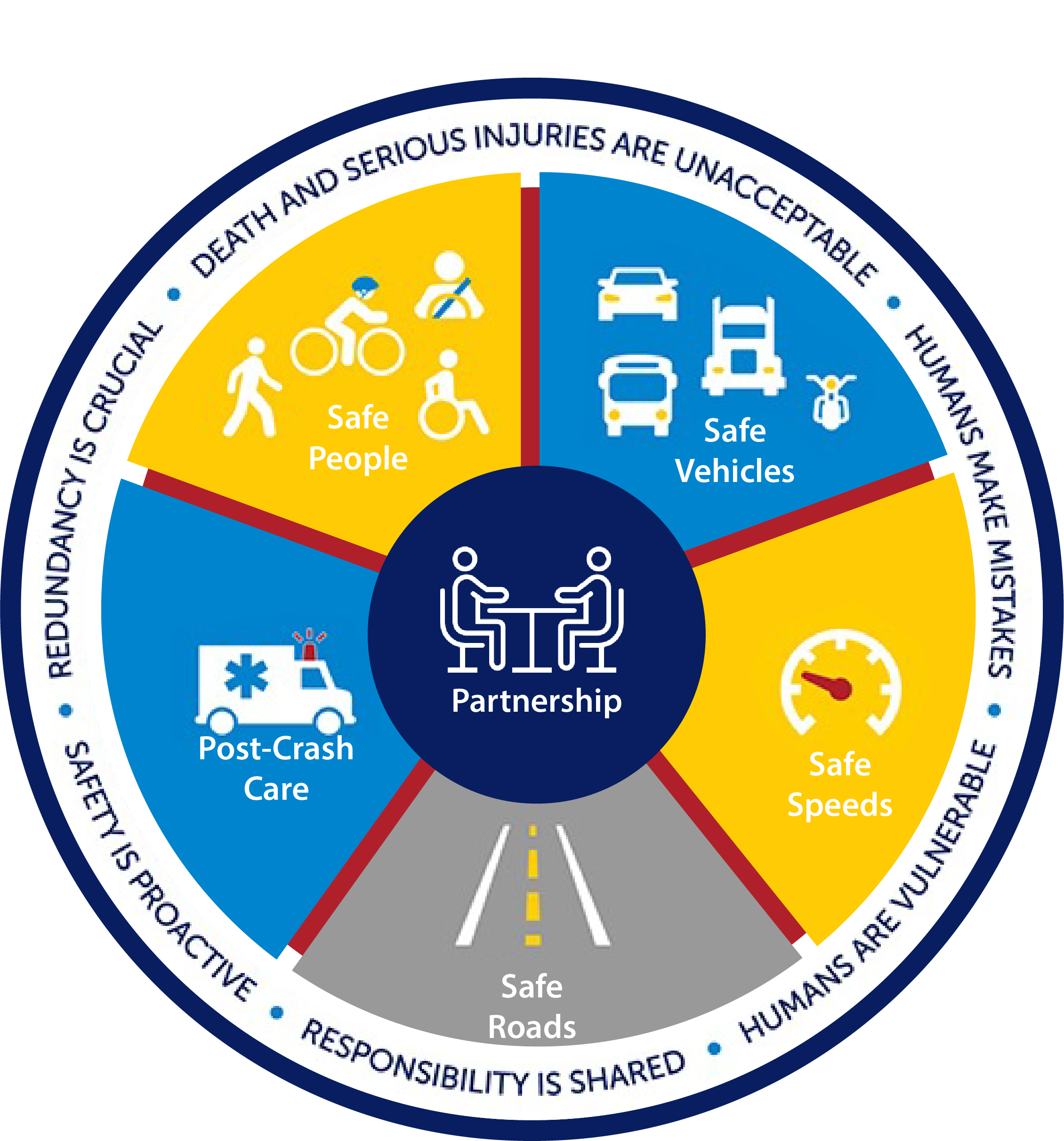
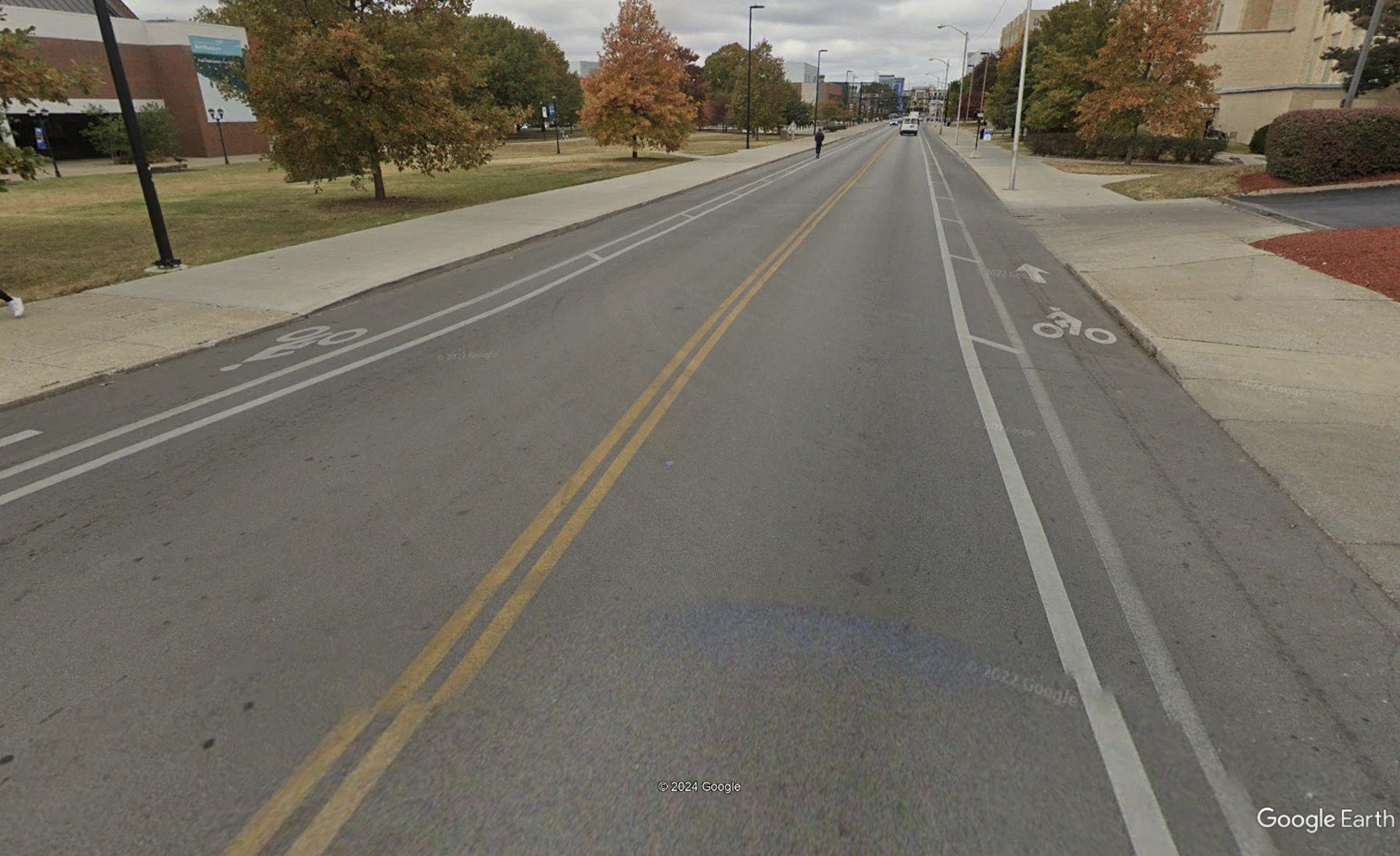
Buffered bike lanes establish a marked buffer between cyclists and vehicle traffic, which can mitigate interactions, conflicts, and crashes between bicyclists and vehicles while creating a network of safer roadways for bicycling. A buffered bike lane is created by separating the bicycle lane from the adjacent general-purpose lane with longitudinal pavement markings that may include chevron or diagonal line markings. If the separation includes a vertical element such as a raised median or pavement-mounted flexible tubular markers or delineators, it becomes a separated bicycle lane. Consistent with the Safe System Approach principle of recognizing human vulnerability, buffered bicycle lanes separate users in space and can enhance safety for all road users.
Implementation Categories
| Area(s) | Planning, Design & Geometrics, Operations & Maintenance |
| Safety Category | 1, 2 |

CONSIDERATIONS
- Reference national guidance from the MUTCD, AASHTO’s Guide for the Development of Bicycle Facilities, and NACTO’s Urban Bikeway Design Guide when designing bicycle facilities. See Figure 9-9: Buffer Design Option in the AAHSTO guide for KYTC’s recommended buffer designs.
- Buffers can be flush with the pavement (i.e., pavement markings) or include vertical elements (e.g., tubular markers, raised medians). Separated bicycle lanes are buffered bicycle lanes with a vertical element of separation.
- Separated bicycle lanes are recommended on roadways with higher vehicle volumes and speeds (e.g., arterials).
- Converting traditional or flush buffered bicycle lanes to a separated bicycle lane with tubular markers can reduce bicycle/vehicle crashes up to 53% (FHWA 2023).
- If raised medians are used to separate facilities, consider roadway drainage and maintenance needs.
- Memorandums of Agreement (MOA) with local governments can be used to assign maintenance responsibility for bicycle facilities.
- Buffered/Protected bike lanes is an engineering strategy in KYTC’s SHSP.
APPLICATION
- KYTC’s Complete Streets, Roads, and Highways Manual requires that bicycle lanes have a buffer on facilities with speed limits > 45 mph.
- Bicycle lanes 6 feet or wider are candidates for buffered bicycle lanes. A 2-foot buffer is preferred, and the bike lane must be at least 4 feet.
- For a buffer space greater than 3 ft wide, chevron or diagonal markings shall be applied. In buffer spaces from 2 ft to 3 ft, chevron or diagonal markings should be applied. For buffer spaces less than 2ft wide, no chevron or diagonal markings may be applied within the buffer. See MUTCD Figure 9E-6.
- Pavement markings should be thermoplastic.
example
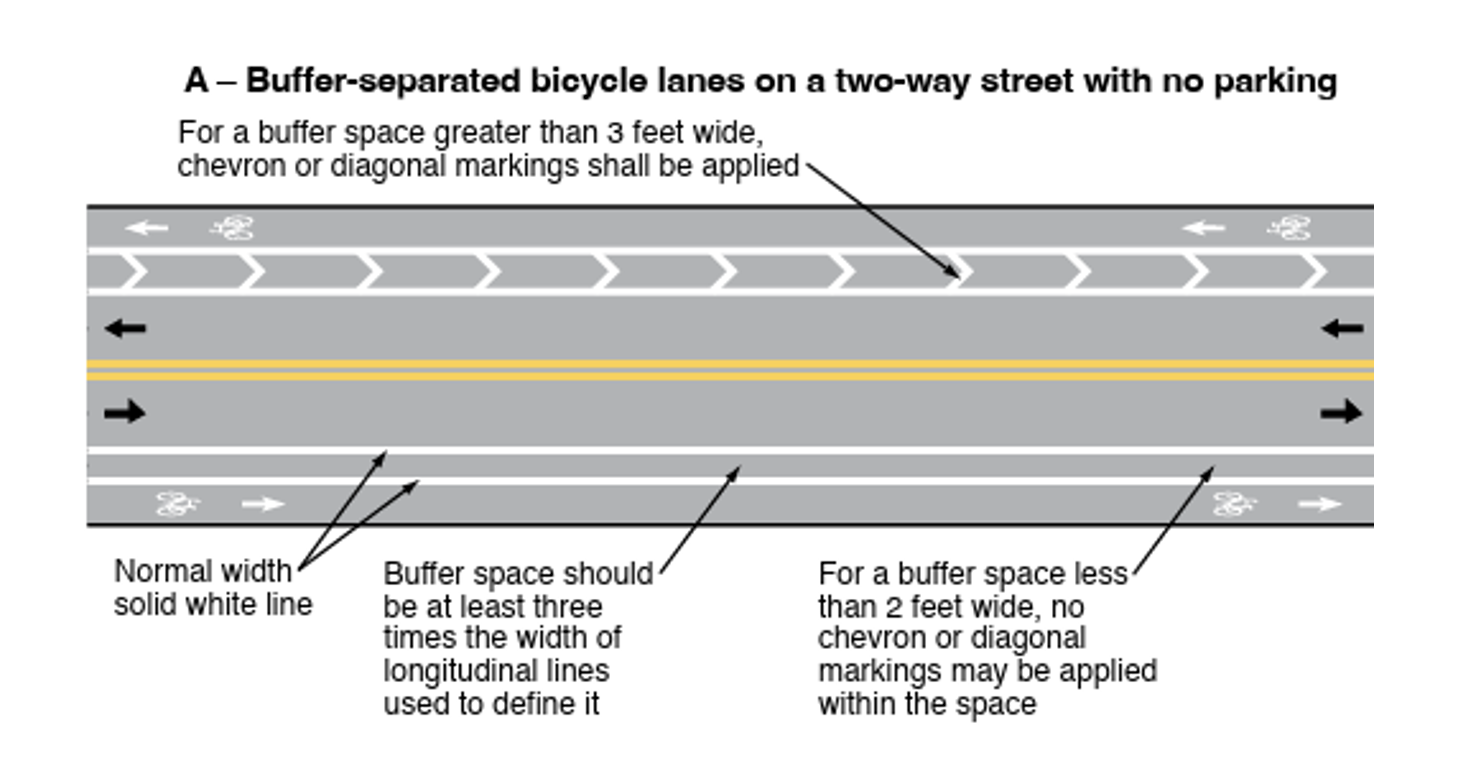
Image Source: MUTCD, 11th Edition, Figure 9E-6
complementary SSA Strategies
REFERENCES AND RESOURCES
American Association of State Highway and Transportation Officials. (2024). Guide for the Development of Bicycle Facilities (5th ed.). Washington, DC: American Association of State Highway and Transportation Officials. ISBN 9781560518204.
FHWA. Proven Safety Countermeasures. https://highways.dot.gov/safety/proven-safety-countermeasures/bicycle-lanes
FHWA. (CMF ID: 11296) Developing CMFs for Separated Bicycle Lanes. FHWA-HRT-23-025, (2023). https://highways.dot.gov/media/30486
KYTC Complete Streets, Roads and Highways Manual (2022). https://transportation.ky.gov/BikeWalk/Documents/Complete%20Streets,%20Roads,%20and%20Highways%20Manual.pdf
CONTACT:
Jill Asher
Research Engineer
jill.asher@uky.edu