
Curb Extensions
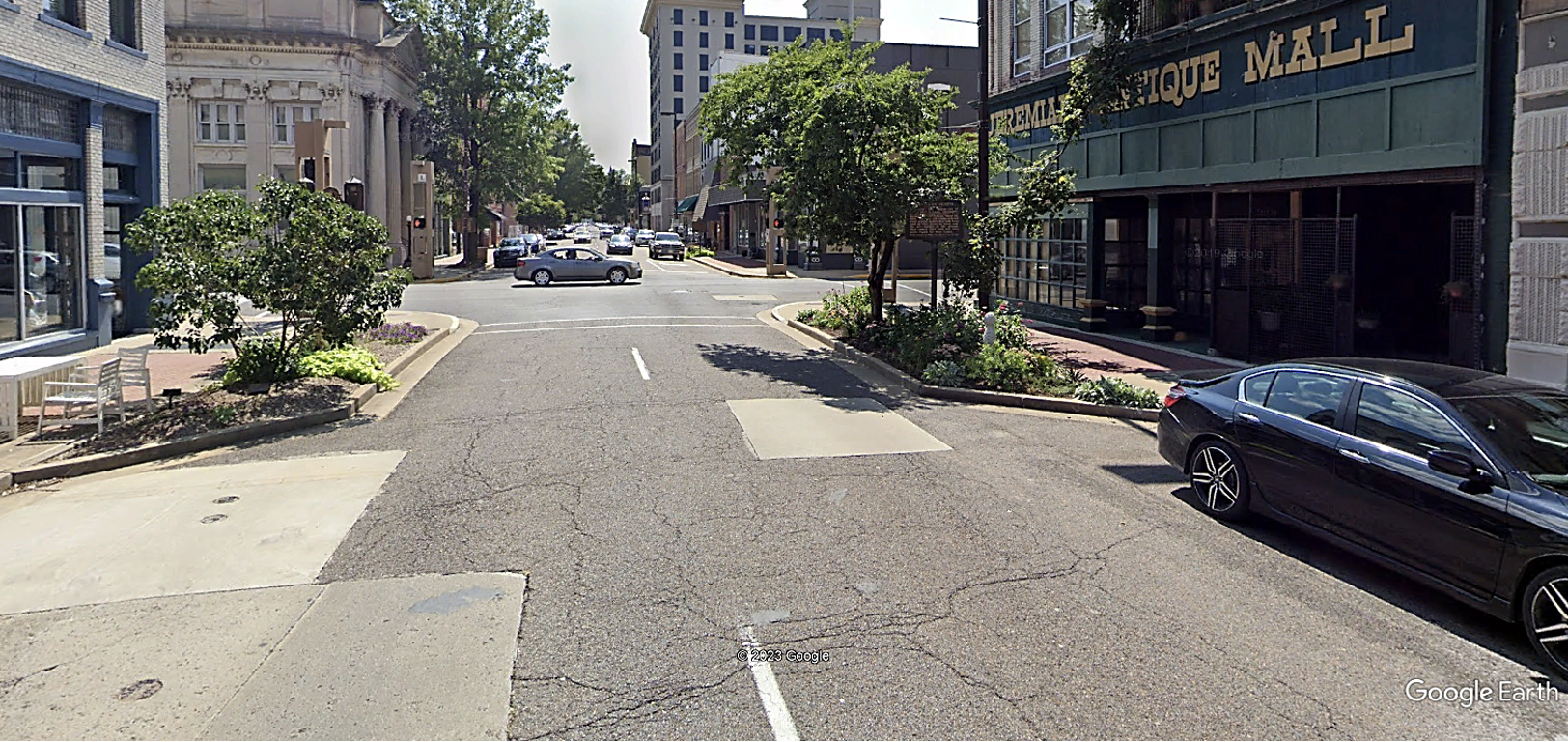
Image Source: Google Earth, Paducah
DEFINITION AND DESCRIPTION
A curb extension is a horizontal extension of the sidewalk into the street that results in a narrower roadway section. They may be placed at intersection corners or mid-block. A curb extension at an intersection is called a corner extension or bulbout. A curb extension located mid-block is called a choker.
Curb extensions increase pedestrian visibility, shorten crossing distance for pedestrians, and encourage pedestrians to cross at designated locations. They also tighten intersection curb radii, encourage slower turning speeds, and prevent vehicles from illegally parking at corners.
Implementation Categories
| Area(s) | Design and Geometrics, HSIP |
| Safety Category | 1, 2 |

CONSIDERATIONS
- Applied on curbed roadways.
- Consider drainage and utility impacts in design.
- May not be appropriate on intersection corners with significant turning volumes of large vehicles. If used, the stop bar on the opposite travel lane on the receiving leg of the intersection may need to be set back to accommodate large vehicles making a turn.
- Generally, not appropriate along primary access routes to commercial or industrial sites or on high-speed rural intersections.
- Tactical curb extensions can be fabricated using low-cost, quick-build materials such as pavement markings and vertical delineators. The gutter can be spanned.
- KYTC Maintenance Agreements with cities often delegate KYTC’s maintenance responsibility to the roadway features between the curbs. Local governments usually maintain the features within right-of-way that are outside of the curbs (e.g. sidewalks).
- Ensure ADA-PROWAG compliance on curb ramps and detectable warning surfaces with the crosswalk.
- For additional information on curb ramp design see the HKP article Pedestrian Curb Ramps.
APPLICATION
- May be used:
- In urban and rural town contexts at pedestrian crossings of curbed roadways
- For local, collector, and arterial streets
- At intersections and midblock crossings
- Recommended at locations with permanent on-street parking.
- In general, extensions should span the width of the shoulder or parking lane. Do not extend curb extensions into bicycle lanes.
- Provide an adequate shy distance between the curb and the travel lane.
- Quick-build installations using paint and delineators may be considered prior to permanent construction.
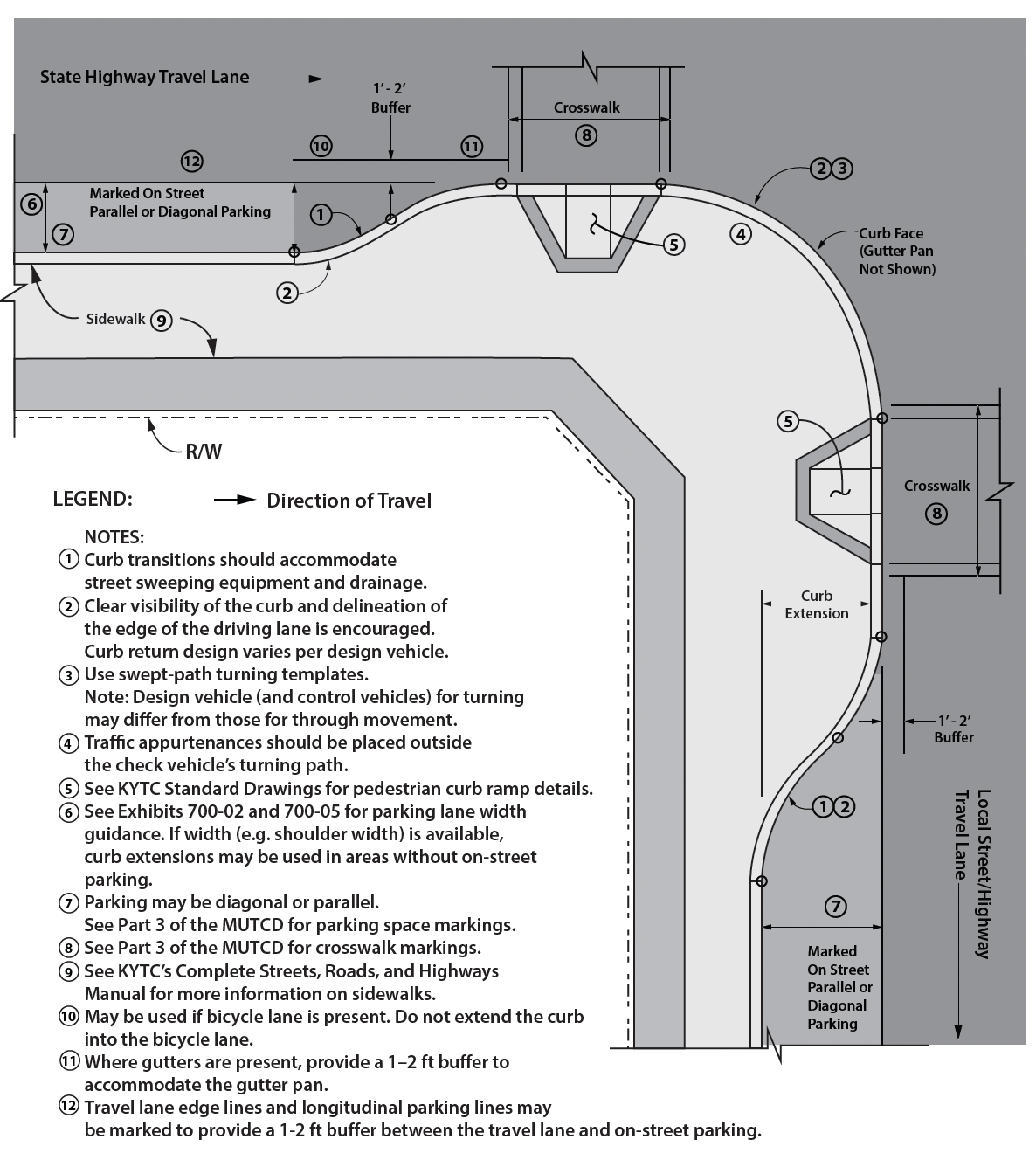
example

complementary SSA Strategies
- Speed Tables and Raised Crosswalks
- Leading Pedestrian Interval
- Centerline Turn Hardening
- Lighting
- Evaluate and Implement Road Reconfigurations
- Rectangular Rapid Flashing Beacon (RRFB)
- Lateral Shifts and Chicanes
- Human Factors Guidance – Countermeasures to Reduce Pedestrian Exposure to Vehicles at Crossings
REFERENCES AND RESOURCES
Torbic, D., D. Gilmore, K. Bauer, C. Bokenkroger, D. Harwood, L. Lucas, R. Frazier, C. Kinzel, D. Petree, and M. Forsberg, NCHRP Report 737: Design Guidance for High-Speed to Low-Speed Transition Zones for Rural Highways, Transportation Research Board of the National Academies, Washington, D.C., 2012. https://www.nationalacademies.org/read/22670
Federal Highway Administration. Manual on Uniform Traffic Control Devices for Streets and Highways (MUTCD), Federal Highway Administration, U.S. Department of Transportation, Washington DC, 2023. Figure 3J-6 Examples of Sidewalk Extensions Designated by Pavement Markings and Channelization. https://mutcd.fhwa.dot.gov/pdfs/11th_Edition/part3.pdf
Federal Highway Administration, Traffic Calming ePrimer. https://highways.dot.gov/safety/speed-management/traffic-calming-eprimer#eprimer
KYTC Complete Streets, Roads, and Highways Manual, 2022. https://transportation.ky.gov/BikeWalk/Documents/Complete%20Streets,%20Roads,%20and%20Highways%20Manual.pdf
CONTACT:
Jill Asher
Research Engineer
jill.asher@uky.edu