Speed Reduction Markings
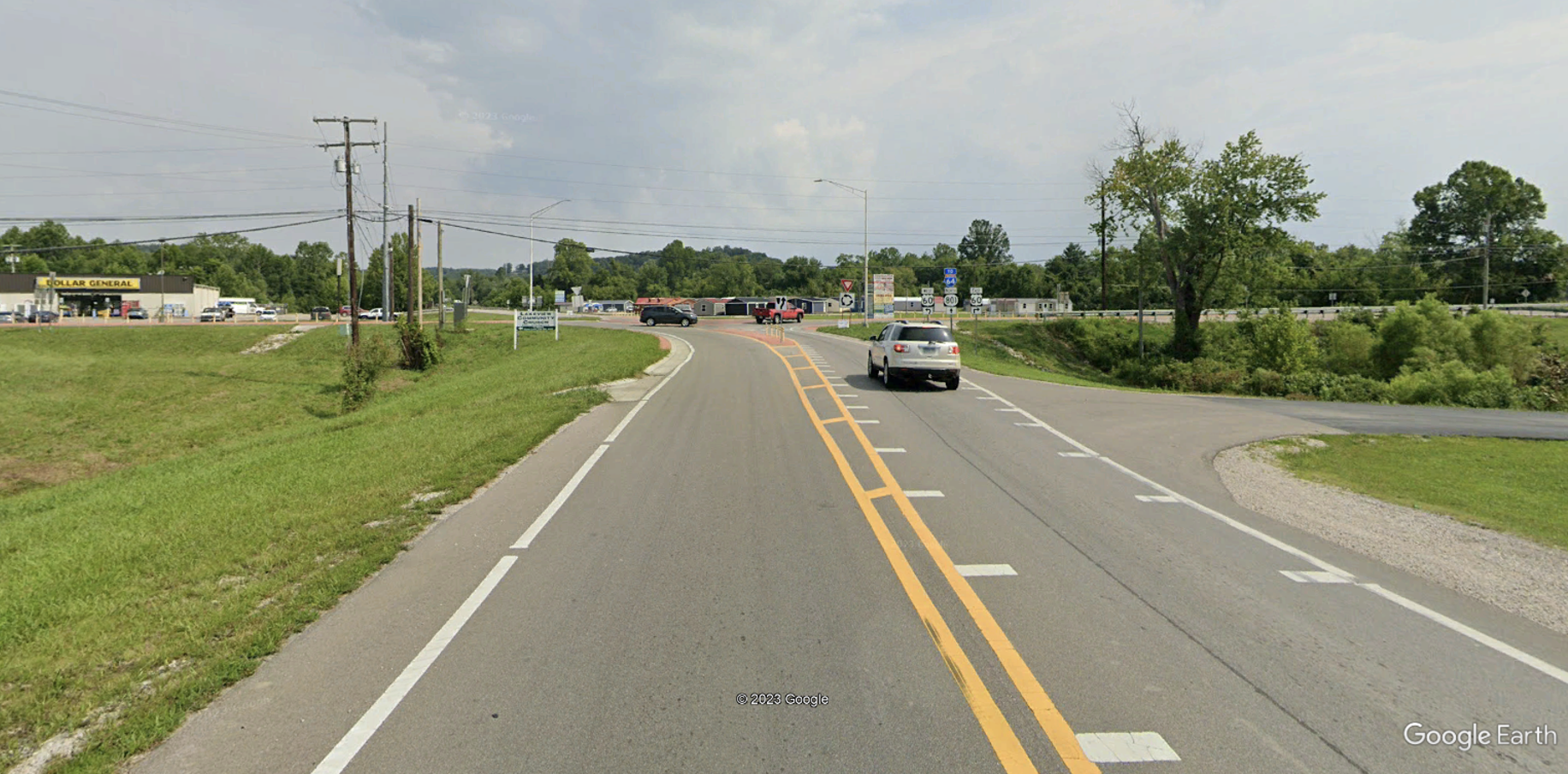
Image Source: Google Earth
DEFINITION AND DESCRIPTION
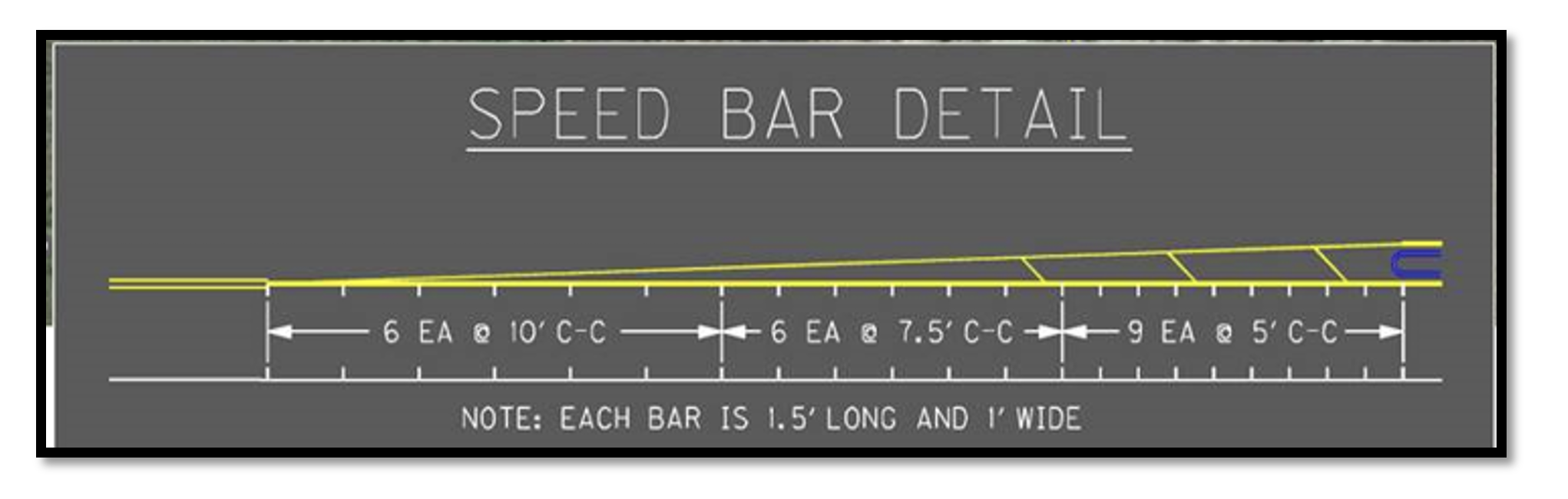
Speed Reduction Markings, or optical speed bars (OSBs), are white transverse pavement markings placed on both sides of a lane perpendicular to the centerline, edge line, or lane line with the goal of reducing vehicle operating speeds. The distance between successive bars is reduced progressively to give motorists the impression that their speed is increasing.
Implementation Categories
| Area(s) | Design and Geometrics, HSIP, Traffic Operations, Operations & Maintenance |
| Safety Category | 2, 4 |

CONSIDERATIONS
- Initial and final spacing depends on the approach speed and the desired speed.
- Speed Reduction Markings can be installed using paint or thermoplastic pavement marking materials.
- Use Speed Reduction Markings in areas with a demonstrated need for additional enhancement of speed transition zones, stop conditions, or changes in horizontal alignment.
- Must accompany appropriate warning signs and other traffic control devices.
APPLICATION
- May be installed at horizontal curves, speed transition zones, and TWSC and AWSC intersections to supplement warning signs or traffic control devices.
- Speed Reduction Markings are 1.5 feet long and 1 foot wide. Consult Section 3B.28 of the MUTCD for guidance.
example
complementary SSA Strategies
REFERENCES AND RESOURCES
Federal Highway Administration. Manual on Uniform Traffic Control Devices for Streets and Highways (MUTCD) Section 3B.28, Federal Highway Administration, U.S. Department of Transportation, Washington DC, 2023. https://mutcd.fhwa.dot.gov/kno_11th_Edition.htm
FHWA, Speed Management: A Manual for Local Rural Road Owners. https://highways.dot.gov/safety/local-rural/speed-management-manual-local-rural-road-owners/3-identifying-countermeasures#:~:text=Optical%20speed%20bars%20are%20used,faster%20than%20their%20true%20speed.
CONTACT:
Jill Asher
Research Engineer
jill.asher@uky.edu