
Back-In Angle Parking

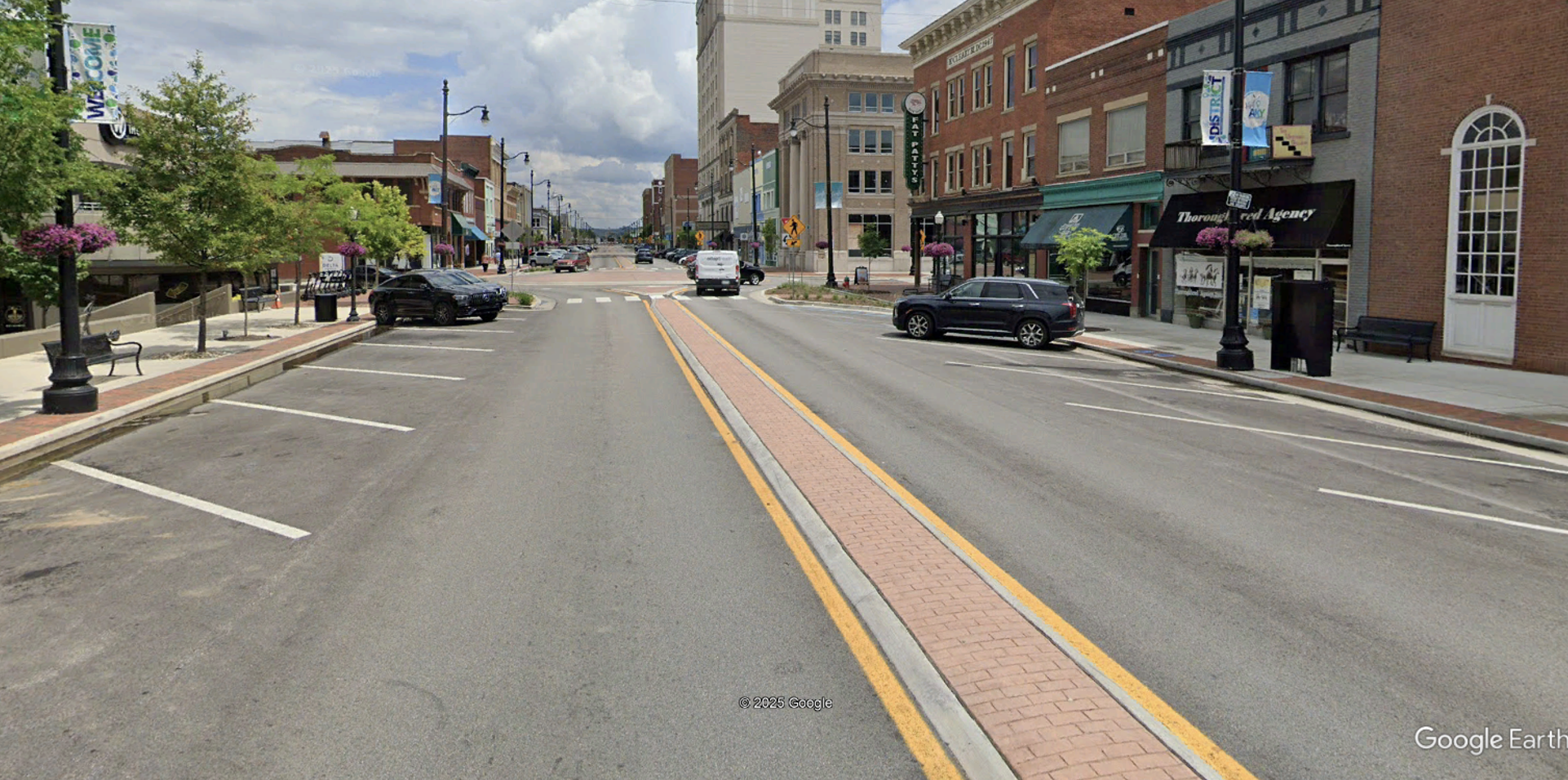
Image Source: Google Earth – Ashland, KY
DEFINITION AND DESCRIPTION
Back-in angle, or reverse angle, parking requires motorists to reverse their vehicle into an angled parking space instead of pulling forward into it. With the front of their vehicle facing the street, a motorist has improved sight distance when leaving a parking space. This type of parking also allows for rear loading at curbs instead of along travel lanes. Additionally, passengers are channeled toward the curb instead of the street.
Implementation Categories
| Area(s) | Design & Geometrics, Traffic Operations |
| Safety Category | 4 |

CONSIDERATIONS
- Because back-in angle parking is uncommon, some drivers may continue to pull forward into parking spaces, especially from the “opposite” intended direction of travel.
- On two-way roadways, non-mountable medians prevent parking in the wrong direction.
- Eliminates the blind spot present when backing out of an angled parking spot. If bicycle lanes are present, this may reduce the risk of collisions with bicyclists.
- Parking spaces should be deep enough to accommodate the lengths of vehicles expected to use them so they do not overhang onto the sidewalk
- It is important to coordinate with local stakeholders before installing back-in angle parking.
- The MUTCD addresses back-in angle parking and includes a standard sign (R7-10) for this application. Refer to MUTCD Section 9B.10 for guidance when back-in angle parking is used in conjunction with a bicycle lane.
APPLICATION
- May be substituted for pull-in angle parking.
- May be used when bicycle lanes are present.
- Can be included in resurfacing projects.
example
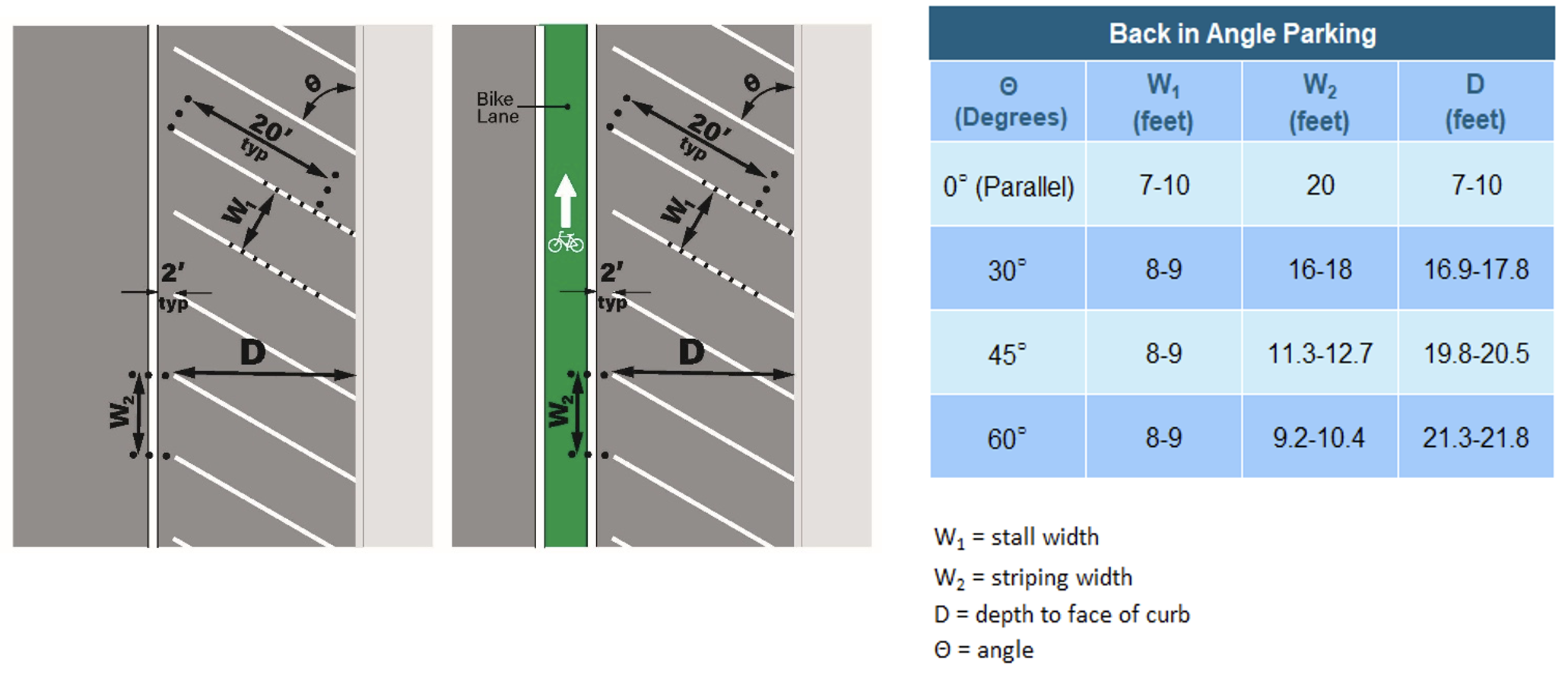
Source: Adapted from FHWA, 2021
Complementary SSA Strategies
- Median and Pedestrian Refuge Island
REFERENCES AND RESOURCES
Federal Highway Administration. Manual on Uniform Traffic Control Devices for Streets and Highways (MUTCD), Federal Highway Administration, U.S. Department of Transportation, Washington DC, 2023. https://mutcd.fhwa.dot.gov/kno_11th_Edition.htm.
FHWA. On-Street Motor Vehicle Parking and the Bikeway Selection Process. 2021. FHWA-SA-21-009. https://highways.fhwa.dot.gov/sites/fhwa.dot.gov/files/2022-06/FHWA-SA-21-009_On_Street_Motor_Vehicle_Parking.pdf
CONTACT:
Jill Asher
Research Engineer
jill.asher@uky.edu