
Curve Widening
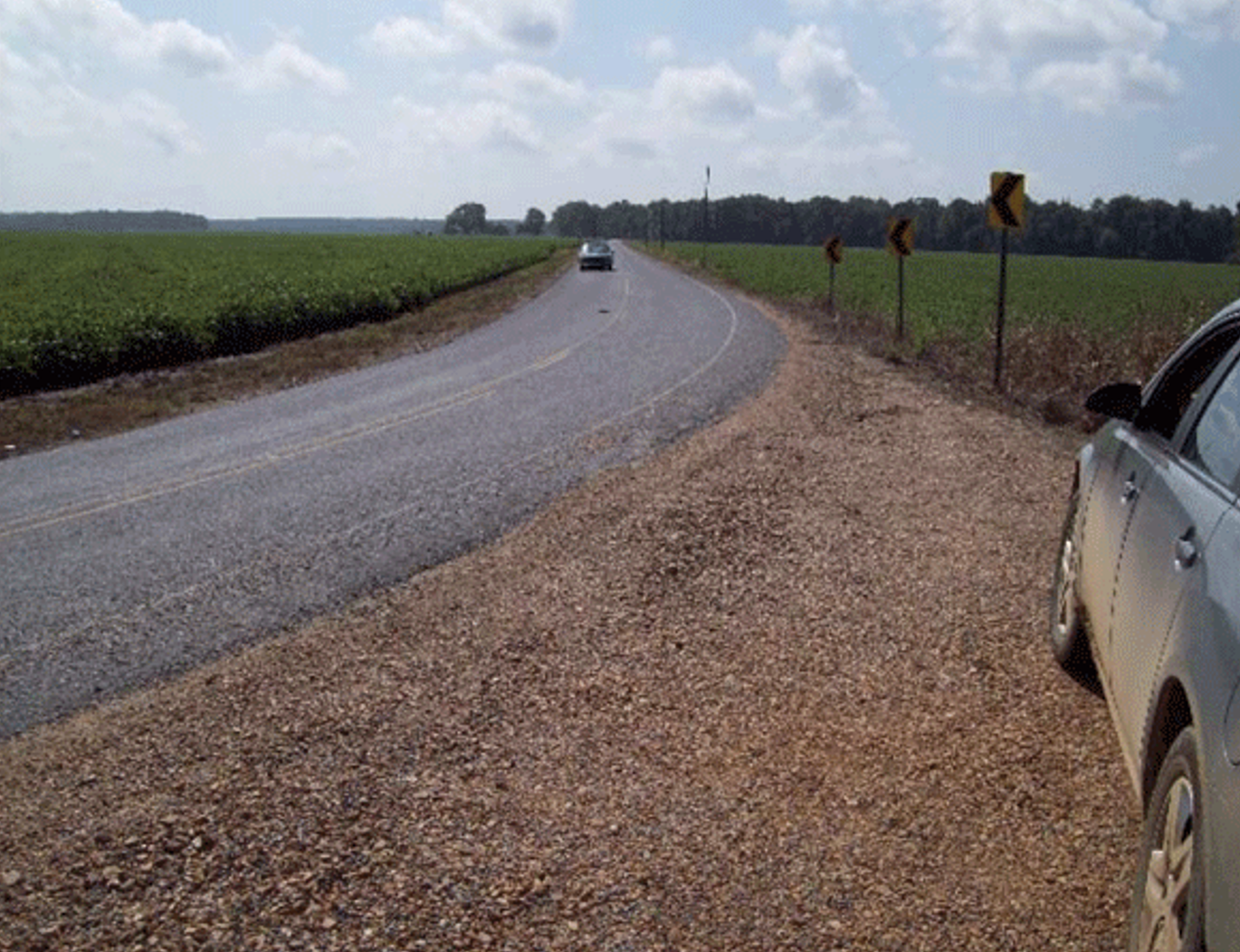
Image Source: FHWA
DEFINITION AND DESCRIPTION
Roadway departure crashes frequently occur on horizontal curves, which are significantly overrepresented in crash statistics. The presence of shoulders—whether paved or unpaved—plays a major role in a driver’s ability to recover control after leaving the traveled way.
While it may not always be feasible to widen highways for continuous shoulders, adding shoulder width at critical locations—such as curves, where roadway departures are more likely—can be beneficial.
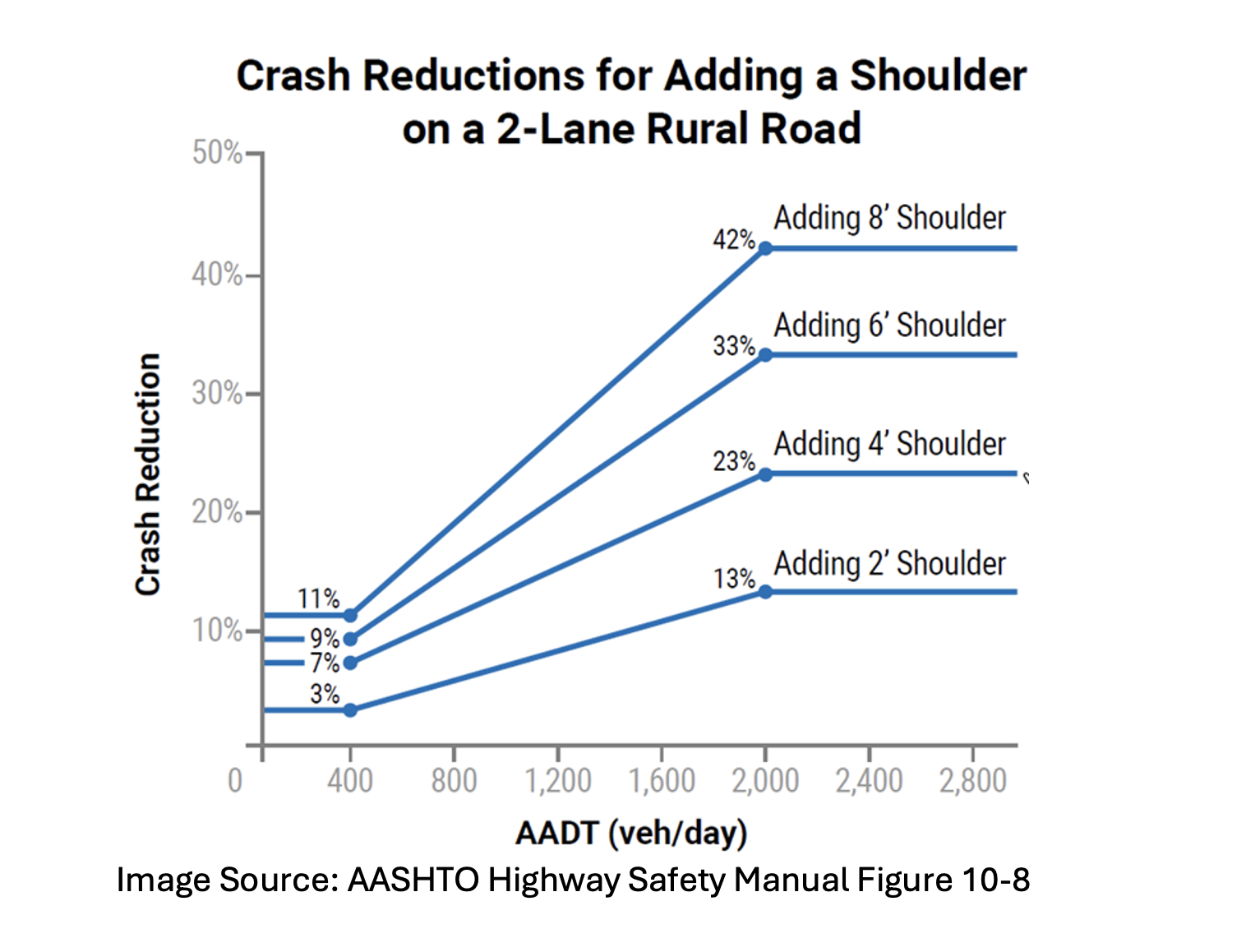
Image Source: AASHTO Highway Safety Manual Figure 10-8
Implementation Categories
| Area(s) | Design & Geometrics |
| Safety Category | 1 |

CONSIDERATIONS
Widen to the Inside of the Curve:
- When traversing a horizontal curve, the rear wheels track inside the front wheels, making it difficult to stay centered in the lane.
- These challenges are greater on narrow lanes and sharp curves.
- Refer to Standard Drawing RGS-001, HDM 702.6, and Chapter 3 of the AASTHO Greenbook.
- Widen pavement by at least 2 feet as per RGS-100.
Widen to the Outside of the Curve:
- Run-off-the-road crashes on curves often move outward from the curve.
- Outside shoulders provide recovery space for errant vehicles.
- Wider shoulders improve driver control and reduce roadway departures.
- Crash reductions observed when adding shoulders on 2-lane rural roads.
APPLICATION
- Use on high-speed roadway curves with narrow shoulders.
- Shoulders may be paved or unpaved, with both providing recovery space and safety benefits.
- Stabilize widened shoulders and minimize steepening of roadside slopes.
example
For widening to the inside of the curve, use Standard Drawing RGS-001.
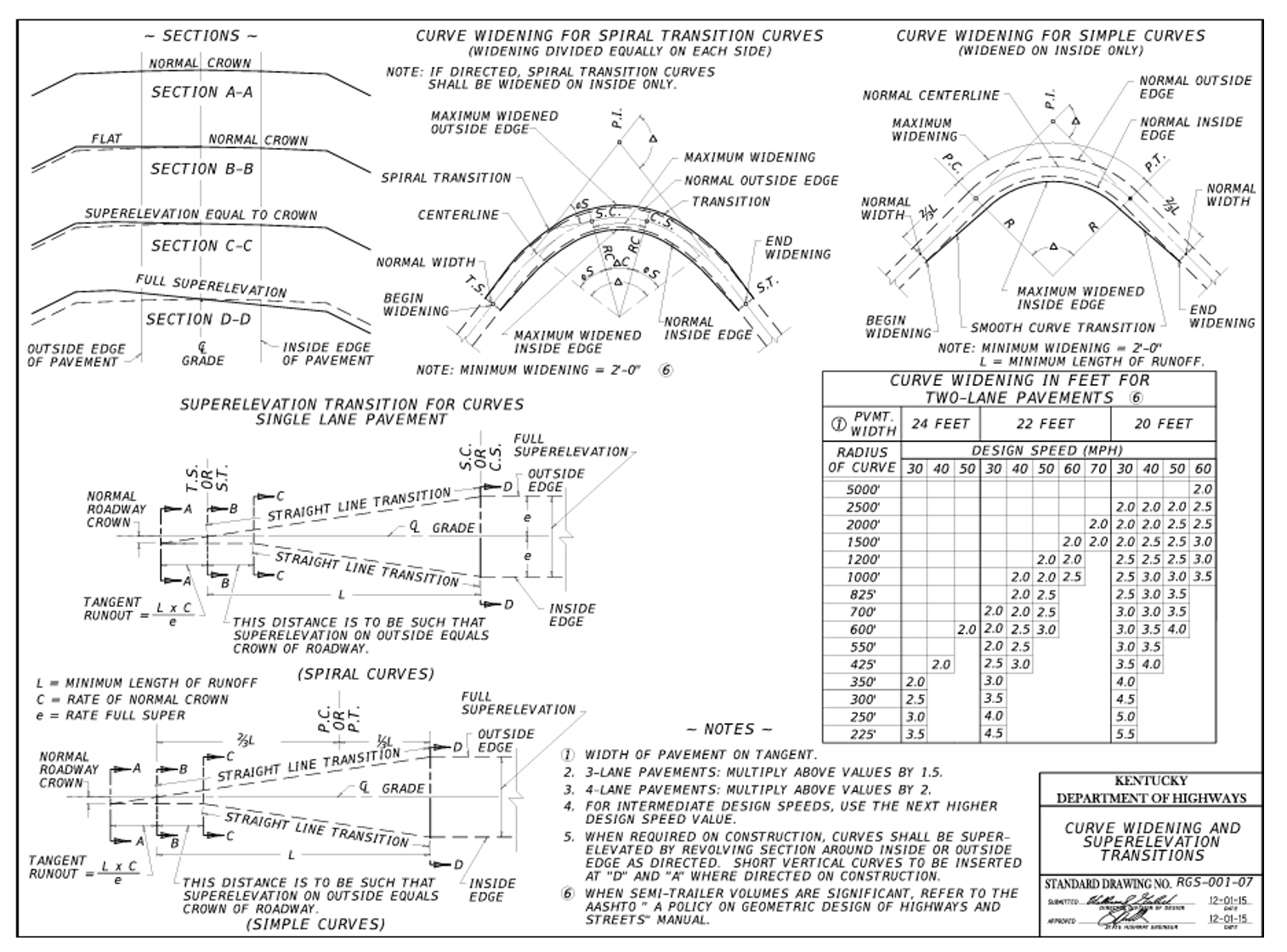
Image Source: KYTC Standard Drawings
Complimentary Countermeasures
- Slope Flattening
- Superelevation Correction
REFERENCES AND RESOURCES
AASHTO. A Policy on Geometric Design o Highways and Streets, 7th Edition. Association of State Highway and Transportation Officials, Washington DC, 2018.
AASHTO. Highway Safety Manual. Association of State Highway and Transportation Officials, Washington DC, 2010.
FHWA. Proven Safety Countermeasure. https://safety.fhwa.dot.gov/provencountermeasures/roadside_design.cfm
FHWA. Low-Cost Treatments for Horizontal Curve Safety 2016. https://safety.fhwa.dot.gov/roadway_dept/countermeasures/horicurves/fhwasa15084/index.cfm#toc
KYTC Highway Design Manual, HD-702.6. https://transportation.ky.gov/Organizational-Resources/Policy%20Manuals%20Library/Highway%20Design.pdf
KYTC Standard Drawings (2025). https://transportation.ky.gov/Highway-Design/Pages/Standard-Drawings.aspx
CONTACT:
Jill Asher
Research Engineer
jill.asher@uky.edu