
Evaluate and Implement Road Reconfigurations
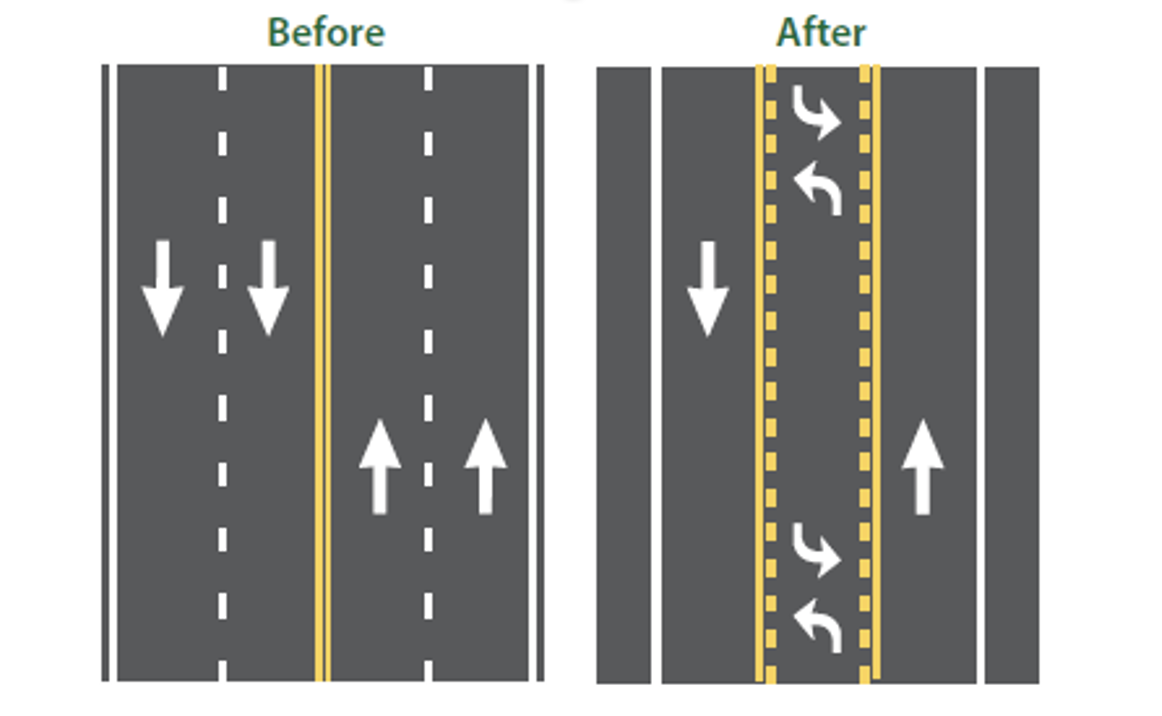
Image Source: FHWA (2014)
DEFINITION AND DESCRIPTION
Roadway reconfigurations can improve safety, calm traffic, and provide better mobility and access for all road users. A reconfiguration can take multiple forms. It can involve converting a four-lane undivided roadway into a three-lane roadway (i.e., road diet) that has two through lanes and a center two-way left-turn lane (TWLTL). Extra roadway width may be used to separate roadway users in space with bicycle lanes or other facilities for vulnerable users. This type of conversion can reduce crashes by 19% – 47%.
Another type of reconfiguration involves keeping the number of travel lanes unchanged while redistributing the widths of roadway cross-sectional elements. Lanes may be narrowed, providing room for wider shoulders, a centerline buffer, a median, or bicycle facilities. Using pavement markings to indicate lateral shifts or chicanes may reduce speeds where a roadway transitions from a high-speed to low-speed context.
Implementation Categories
| Area(s) | Operation & Maintenance, Design & Geometrics, Traffic Operations |
| Safety Category | 1, 2 |

CONSIDERATIONS
- Road diets may be applicable for mainline ADTs up to 23,000. However, side-street volumes must also be considered. Higher traffic volumes indicate the need for an operational analysis.
- Requires a plan for modifying signing and striping, intersection markings, and on-street parking (where applicable).
- Traffic signal heads may need to be adjusted to align with new lane positions.
- If the new road configuration is not applied to the entire length of roadway with similar cross sections, transitions may be established through a mid-block lane reduction (with adequate tapers) or a lane drop at an intersection.
- Reconfiguring lanes in one direction but not another may be acceptable.
- The Traffic Operations Guidance Manual (TO-206) requires a public information/outreach effort for road diets.
- Additional time may be required to coordinate with local officials and stakeholders.
- The ideal time to consider a roadway reconfiguration is when the route is scheduled for resurfacing. This allows the reconfiguration to be implemented at minimal additional cost, limited primarily to adjusting signs and signals.
- If the project is designed using HSIP funds, an environmental document may be needed for the design component.
APPLICATION
- Evaluate a facility’s safety performance, pavement width, traffic volumes, user mix, land use, roadway context, and presence of speed transition zones.
- If it is feasible to modify use of existing roadway width to better align with SSA principles, determine new allocation of the cross-section width. Options include:
- Road Diet
- Buffered Bike Lanes
- Centerline Buffers
- Narrowing Travel Lanes/Shoulder Widening
- Median and Pedestrian Refuge Island
- Lateral Shifts and Chicanes
- On-street parking layouts
- Develop striping and signing plans for inclusion in the roadway project or resurfacing proposal. Note locations of rumble strips. Some applications may include raised features such as medians or bollards.
Note: The Traffic Safety Branch within the Division of Traffic Operations has compiled a list of potential road diet candidate locations. Contact them for additional information.
example
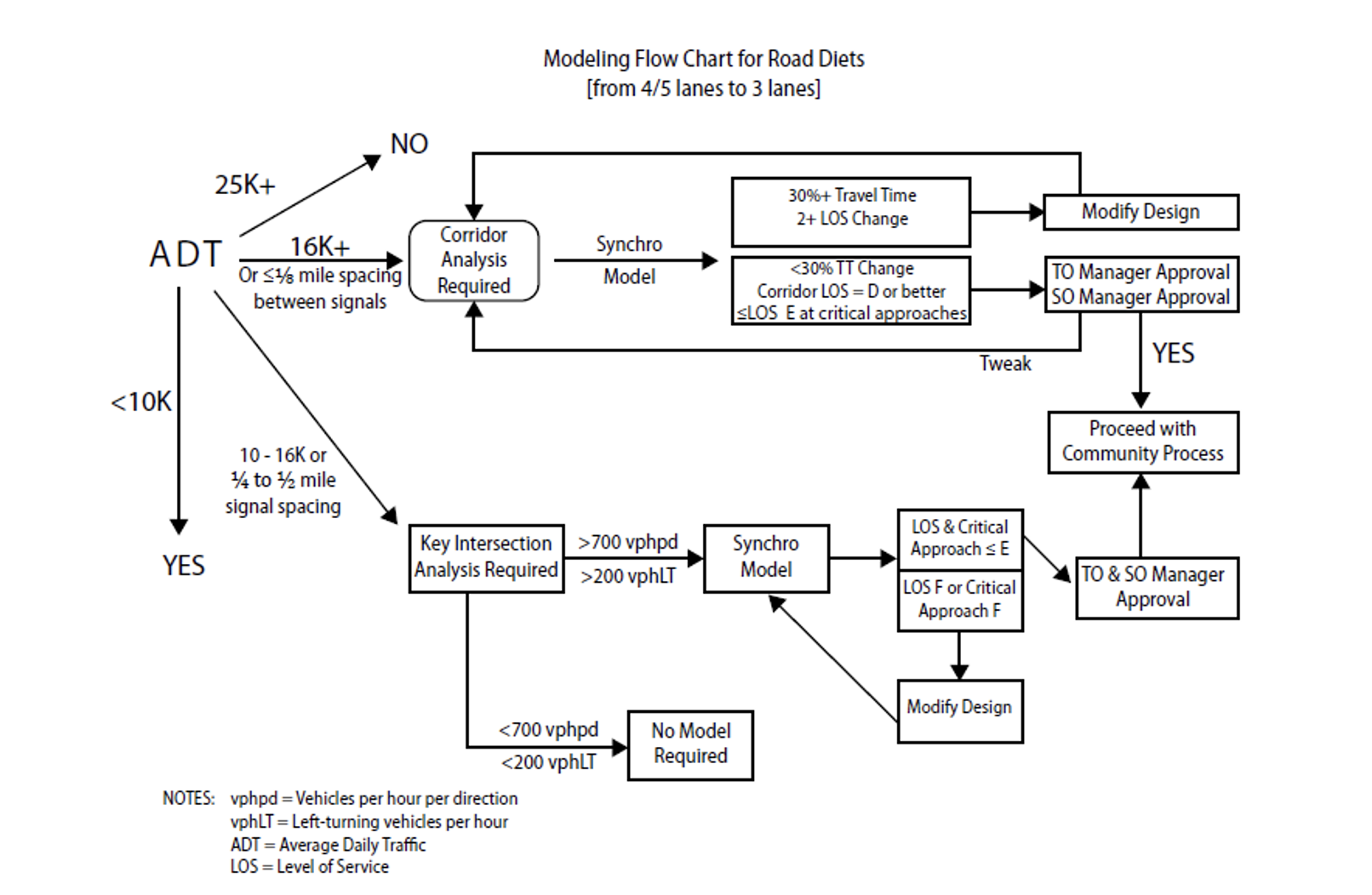
Image Source: FHWA’s Road Diet Informational Guide (2014)
Complimentary Countermeasures
- Buffered Bike Lanes
- Centerline Buffers
- Road Narrowing — Pavement Markings
- Lateral Shifts and Chicanes
- Back-in Angle Parking
- Median and Pedestrian Refuge Islands
- Curb Extensions
REFERENCES AND RESOURCES
FHWA. Road Diet Informational Guide. (2014) https://highways.dot.gov/safety/other/road-diets/road-diet-informational-guide
FHWA Proven Safety Countermeasures
Stamatiadis, N., Kirk, A., Wang, C., and Cull, A. (2011) Guidelines for Road Diet Conversions, KTC-11-20, Kentucky Transportation Center, Lexington, KY. https://uknowledge.uky.edu/cgi/viewcontent.cgi?article=1017&context=ktc_researchreports
CONTACT:
Jill Asher
Research Engineer
jill.asher@uky.edu