
Friction Surface Treatments
DEFINITION AND DESCRIPTION
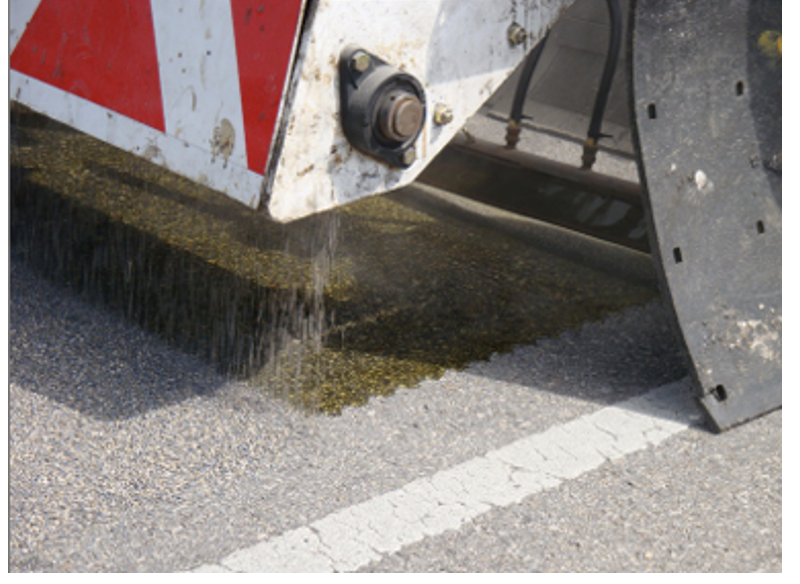
High friction surface treatments (HFSTs) consist of high-quality aggregate bonded to pavement using a polymer binder. They restore and/or maintain pavement friction in areas with high crash rates or which are at risk for high crash rates. HFST applications can reduce crashes, injuries, and fatalities associated with friction demand issues, such as:
- Reduced pavement friction during wet conditions, and/or
- High friction demand due to vehicle speed and/or roadway geometrics.
HFSTs can lower wet weather crashes up to 83 percent and total crashes up to 57 percent. Other friction treatments may also be considered.
Implementation Categories
| Area(s) | Design & Geometrics, HSIP, Operations & Maintenance |
| Safety Category | 1 |
CONSIDERATIONS
- If using a Master Agreement, HFST application should be coordinated with the roadway resurfacing schedule.
- Includes a two-part epoxy binder with calcined bauxite aggregate on dense graded asphalt.
- Requires sweeping immediately following installation and three days after installation.
- To improve friction in some of the initial braking area, the starting and stopping points for HFST applications on horizontal curves are generally 40 ft – 100 ft upstream of the point of curvature and 50 ft –100 ft downstream of the point of tangency.
- Common practice is to treat anywhere from 200 ft – 1,000 ft of approach to the intersection depending on where crashes are occurring.
- If HFST will not cover centerline or edge line striping, the inspector must ensure it is placed adjacent to the stripe.
- HFST may not be suitable for pavement sections greater than 0.5 miles in length. If longer sections require treatment, other friction treatments such as high velocity surface texturing, microsurfacing, strip patching, etc. should be considered.
APPLICATION
- Good candidate locations for friction surface treatments include loop ramps, rural curves, and intersections, particularly those with a history of crashes at locations where downhill approaches make it harder to stop when a signal turns red.
example
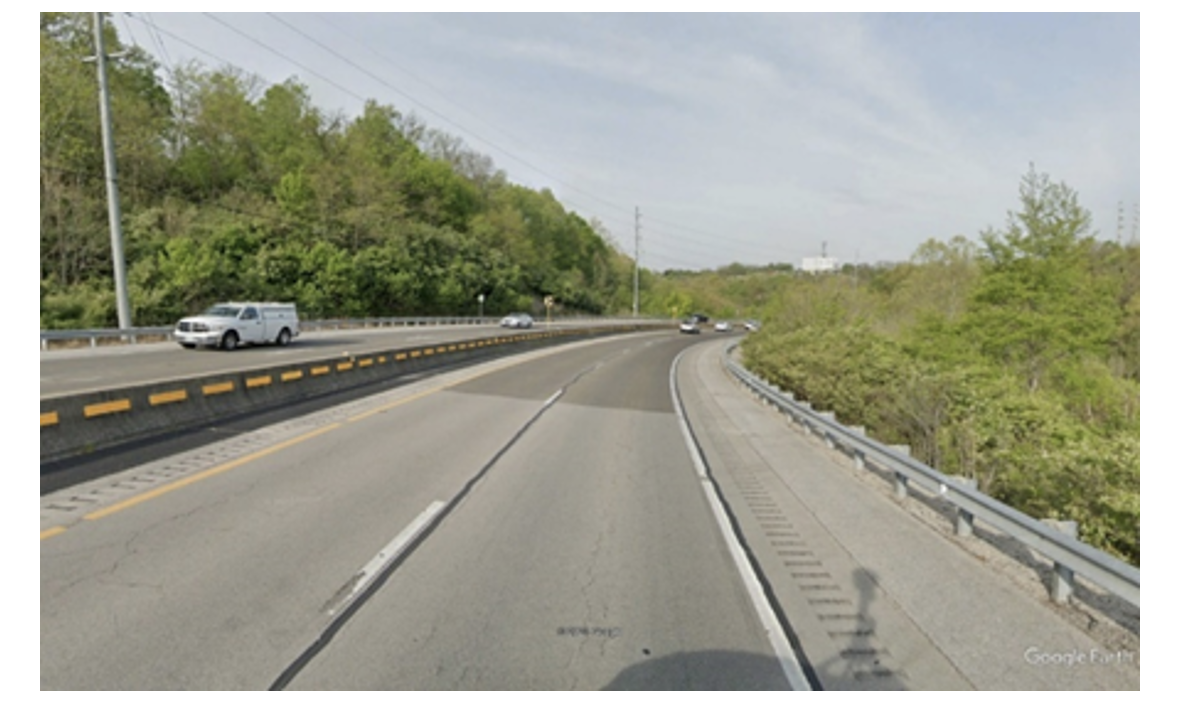
Image Source: Google Earth (KY 676, Frankfort, KY)
Complimentary Countermeasures
- Enhanced Signing
REFERENCES AND RESOURCES
Federal Highway Administration, High Friction Surface Treatment: Site Selection and Installation Guide (2021). U.S. Department of Transportation, Washington, DC, available at: https://highways.dot.gov/sites/fhwa.dot.gov/files/2022-06/HFST_Guide_HPA.pdf
Federal Highway Administration, High Friction Surface Treatment, Case Study: Kentucky’s Site Selection and Field Installation. U.S. Department of Transportation, Washington, DC, available at: https://highways.dot.gov/sites/fhwa.dot.gov/files/2022-06/ky_hfst_15_038.pdf
FHWA. Improving Pavement Friction for Safety at Florida Signalized Intersection. 2021. https://highways.dot.gov/safety/rwd/keep-vehicles-road/pavement-friction/report-improving-pavement-friction-safety-florida
CONTACT:
Jill Asher
Research Engineer
jill.asher@uky.edu