
Increase Use of Roadside Barriers and End Terminals

DEFINITION AND DESCRIPTION
When it is not feasible to remove or relocate a roadside obstacle, it may be shielded by a longitudinal traffic barrier or crash cushion. A roadside barrier redirects or contains errant vehicles, improving safety by preventing more severe outcomes. Barrier examples include guardrail, cable rail, and concrete barriers.
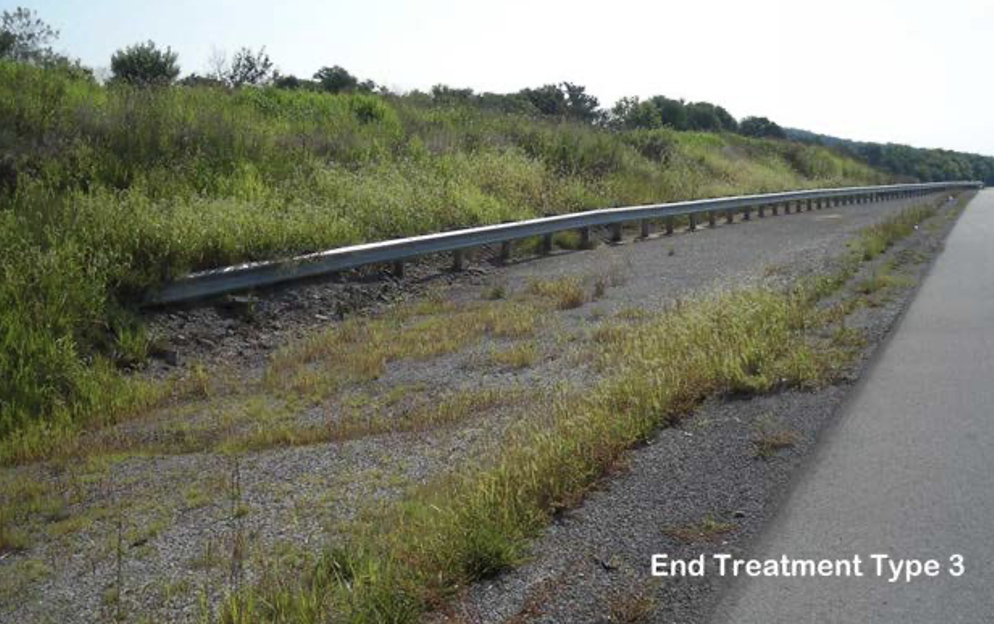
Barrier end treatments (e.g., anchorages, terminals, crash cushions) are essential components that safely absorb or redirect vehicle impacts at the ends of barriers. Proper end treatment selection and installation are critical, as untreated barrier ends can pose severe hazards.
The Crash Modification Factor (CMF) Clearinghouse contains several CMFs for adding new guardrail along embankments. Guardrail installations can reduce run-off-road injury crashes by up to 47% and fatal crashes up to 44%.
Implementation Categories
| Area(s) | Design & Geometrics, HSIP, Operations & Maintenance |
| Safety Category | 1 |

CONSIDERATIONS
- The Roadside Design Guide uses length-of-need calculations to determine how much barrier is required to shield an obstacle. KYTC applies a fixed 15-degree departure angle, producing shorter barrier lengths than AASHTO’s method. See the Highway Knowledge Portal article Length of Need for more information. For higher-risk sites, KYTC may instead use AASHTO’s calculation or a smaller departure angle to provide added shielding.
- The Manual for Assessing Safety Hardware (MASH) provides current crash-testing criteria for roadside safety features used on the National Highway System (NHS).
- Barriers and end treatments may require additional clear width for working width and deflection.
- Consider review and evaluation of barriers and end treatments on low-volume facilities off the NHS.
- KYTC’s Guardrail Rating Program prioritizes guardrail installation locations.
APPLICATION
- Prioritize candidate locations based on crash data, traffic volumes, and roadway characteristics (e.g., curvature, lane width, roadside slopes, fixed-objects).
- Incorporate barrier installation as part of resurfacing, reconstruction, or safety improvement projects to minimize additional cost.
example
complementary Countermeasures
REFERENCES AND RESOURCES
AASHTO. Roadside Design Guide (RSG) 4th Edition. American Association of State Highway Transportation Officials, Washington DC, 2011.
KTC. Guardrail. Highway Knowledge Portal. 2023. https://kp.uky.edu/knowledge-portal/articles/guardrail/
Howell, Brian K.; Staats, William Nicholas; and Albright, Nancy, “Evaluation of Guardrail Needs and Update of Guardrail Rating Program” (2019). Kentucky Transportation Center Research Report. 1634.
https://uknowledge.uky.edu/ktc_researchreports/1634
CONTACT:
Jill Asher
Research Engineer
jill.asher@uky.edu