
Lighting
DEFINITION AND DESCRIPTION
Lighting can be installed continuously along segments of roadway, at intersections, and at spot locations to improve visibility of the roadway, other vehicles, and pedestrian crossings. Limited visibility contributes to nighttime collisions. KYTC’s Complete Streets Manual includes references to roadway lighting and multimodal lighting.
Despite 25% of travel taking place at night, approximately half of all traffic fatalities occur during this period. Lighting can reduce nighttime injury crashes on rural and urban highways up to 28%, nighttime injury pedestrian crashes at intersections up to 42%, and nighttime crashes at rural and urban intersections between 33% – 38% (FHWA, 2023).
Implementation Categories
| Area(s) | Traffic Operations |
| Safety Category | 4 |

CONSIDERATIONS
- KYTC may establish agreements with local governments or electric utility companies to design, install, operate, and maintain lighting on state-maintained roadways. Within a city limit, KYTC does not maintain or pay for lighting.
- The Division of Traffic Operations oversees the evaluation of lighting warrants. Refer to Section TO-203 for the approval authority for various types of lighting. Refer to the Lighting Chapter of the TOGM for other guidance related to lighting.
- KYTC’s Traffic Operations Guidance Manual does not specifically address multimodal lighting.
- KYTC’s Complete Streets Manual includes FHWA’s recommendation that lighting always be considered at mid-block and other uncontrolled pedestrian crossings.
- Solar-powered streetlights are a newer option that lessens the operational cost.
APPLICATION
- Install lighting along roadways and near intersections with a history of nighttime injury or fatality crashes or at intersections with higher pedestrian use.
example

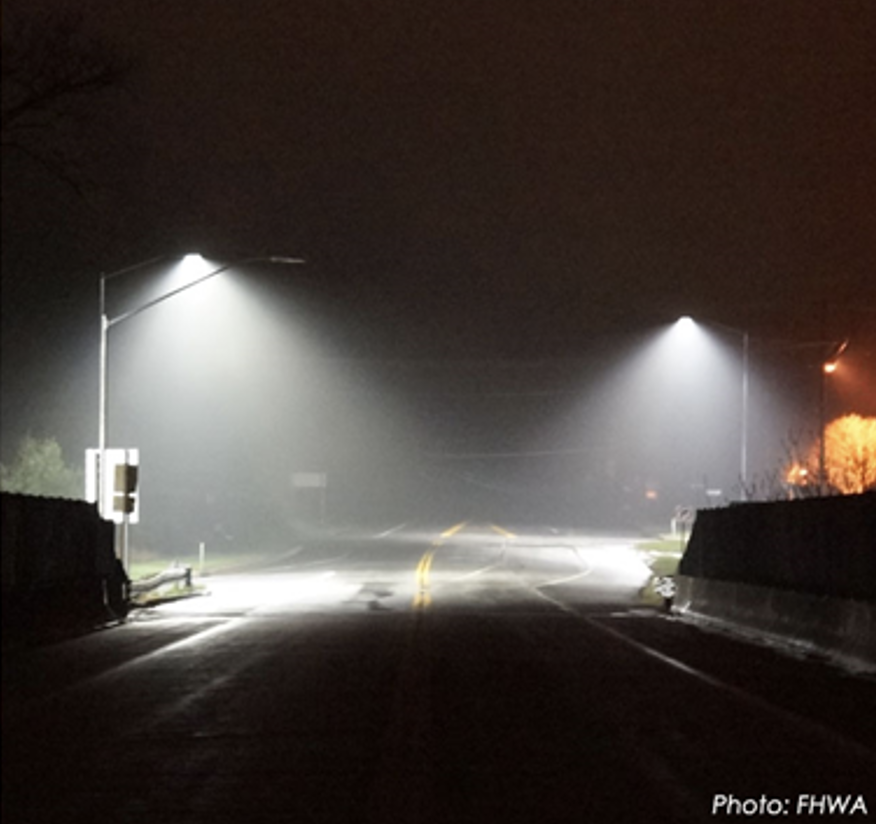
Image Source: FHWA, 2008. Luminaires perpendicular to the approach provide a postive contrast of the pedestrian.
REFERENCES AND RESOURCES
CONTACT:
Chris VanDyke
Research Scientist | Program Manager
chrisvandyke@uky.edu