
Slope Flattening

DEFINITION AND DESCRIPTION
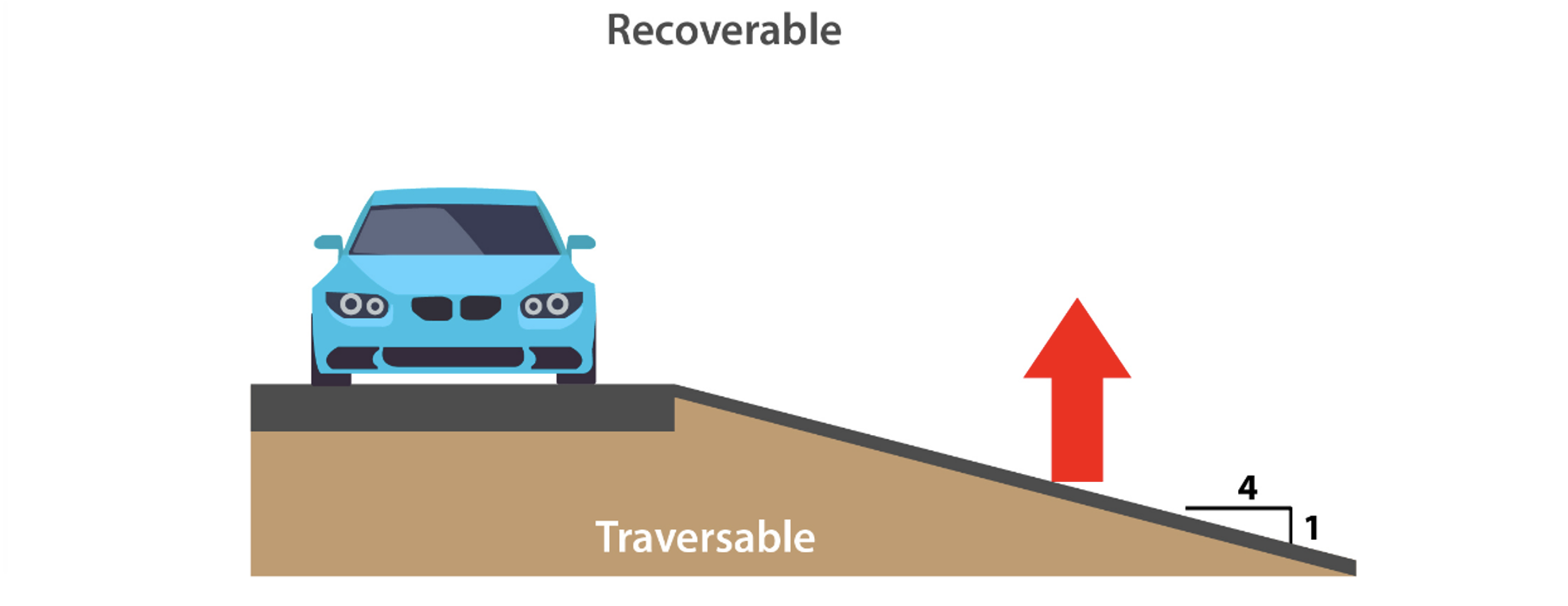
Slope flattening reduces the steepness of the roadside and median slopes so that errant motorists are more likely to keep their vehicles stable, regain control, and avoid obstacles. Slopes of 4H:1V or flatter are recoverable (i.e., motorists can retain control of a vehicle by slowing or stopping). Slopes between 3H:1V and 4H:1V are generally considered traversable, but non-recoverable (i.e., the errant vehicle will continue to the bottom of the slope).
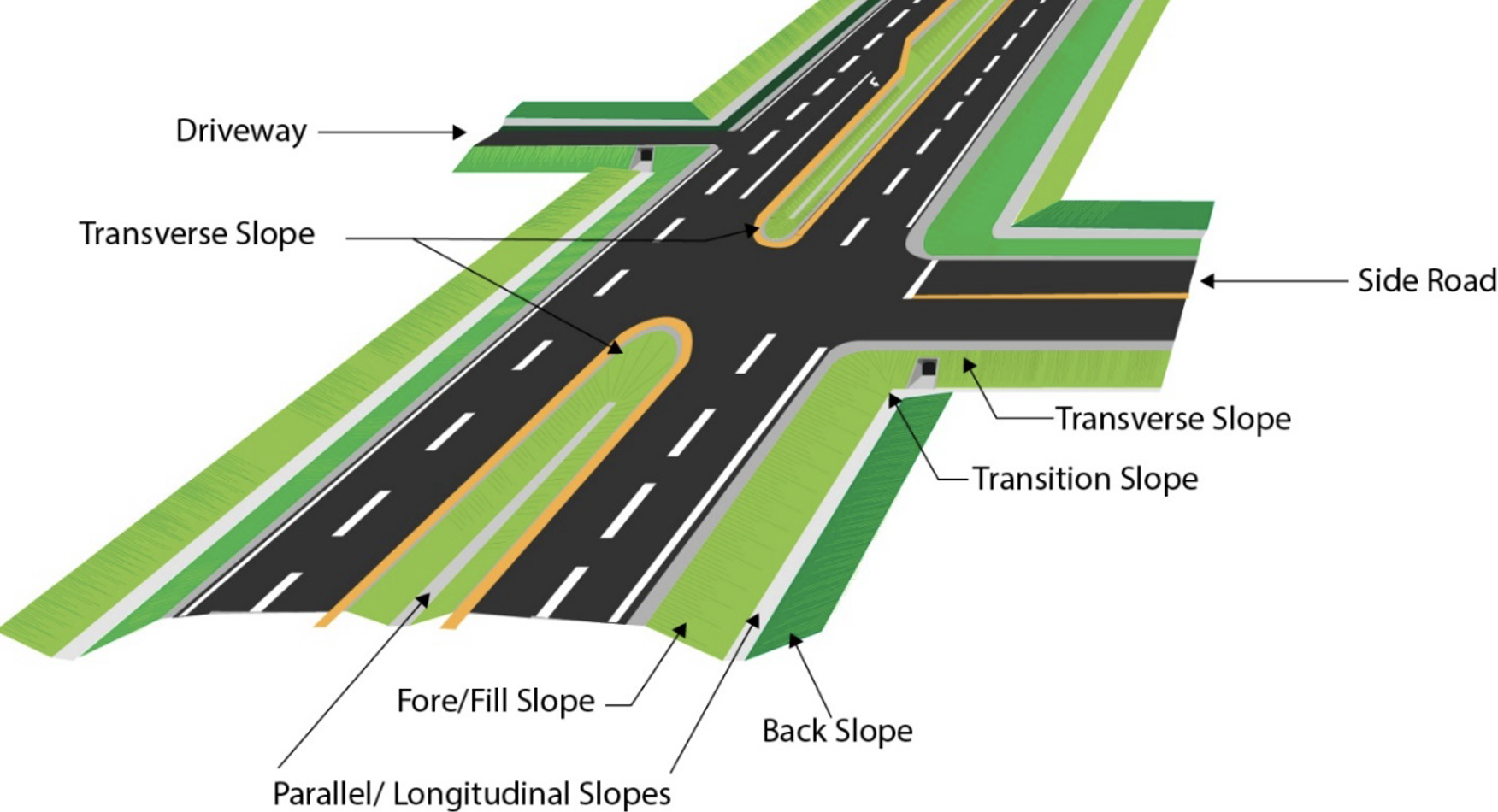
Foreslopes, or fill slopes, are parallel to the flow of traffic and are negative slopes extending from the roadway shoulder down to the ditch or toe. The backslope is a positive slope that extends upward from the base of the foreslope or toe of the ditch. Transverse slopes are not parallel to the roadway and are usually created by median crossovers, berms, driveways, or intersecting roadways.
Implementation Categories
| Area(s) | Design & Geometrics, Operations & Maintenance |
| Safety Category | 1 |

CONSIDERATIONS
- Slope flattening can improve fill slope stability and safety.
- Right-of-way or space constraints may restrict usage.
- When restrictions prevent slope flattening, roadside barriers are an option to shield steep embankments.
- See AASHTO’s Roadside Design Guide (RDG) for more information on recoverable slopes and clear zone distances.
- Can be done on new construction or reconstruction projects or at high-risk sites (e.g., outside of curves, near fixed objects) to improve safety.
- On large earthwork projects with excess material, a false ditch / false cuts in steep embankment areas to simulate the effect of a cut slope and provides a wider recovery area.
- Coordinate with drainage design—flatter slopes may change ditch capacity and runoff.
APPLICATION
- When feasible, design or correct side slopes with recoverable or traversable foreslope and back slope gradients the width of the clear zone. Slopes of 4H:1V or flatter are preferred for foreslopes.
- Transverse slopes of 6H:1V or flatter are recommended, particularly for sections immediately adjacent to traffic. On high-speed roadways transverse slopes are often 10H:1V or flatter.
- In clear zones, include traversable headwalls unless the headwall is protected by a barrier. See KYTC’s Drainage Manual (DR-606.5) and the Sloped and Mitered Concrete Headwall detail sheets for additional information on safety headwalls and their applications
- Coordinate slope design with drainage and maintenance needs.
example
complementary SSA Strategies
REFERENCES AND RESOURCES
AASHTO. Roadside Design Guide. 4th ed. American Association of State Highway and Transportation Officials, Washington, DC., 2011.
FHWA. Roadside Design Improvements at Curves. https://highways.dot.gov/safety/proven-safety-countermeasures/roadside-design-improvements-curves
Highway Knowledge Portal. Clear Zone Concepts. https://kp.uky.edu/directory/knowledge-books/clear-zone-concepts-knowledge-book/
CONTACT:
Jill Asher
Research Engineer
jill.asher@uky.edu