
Speed Hump

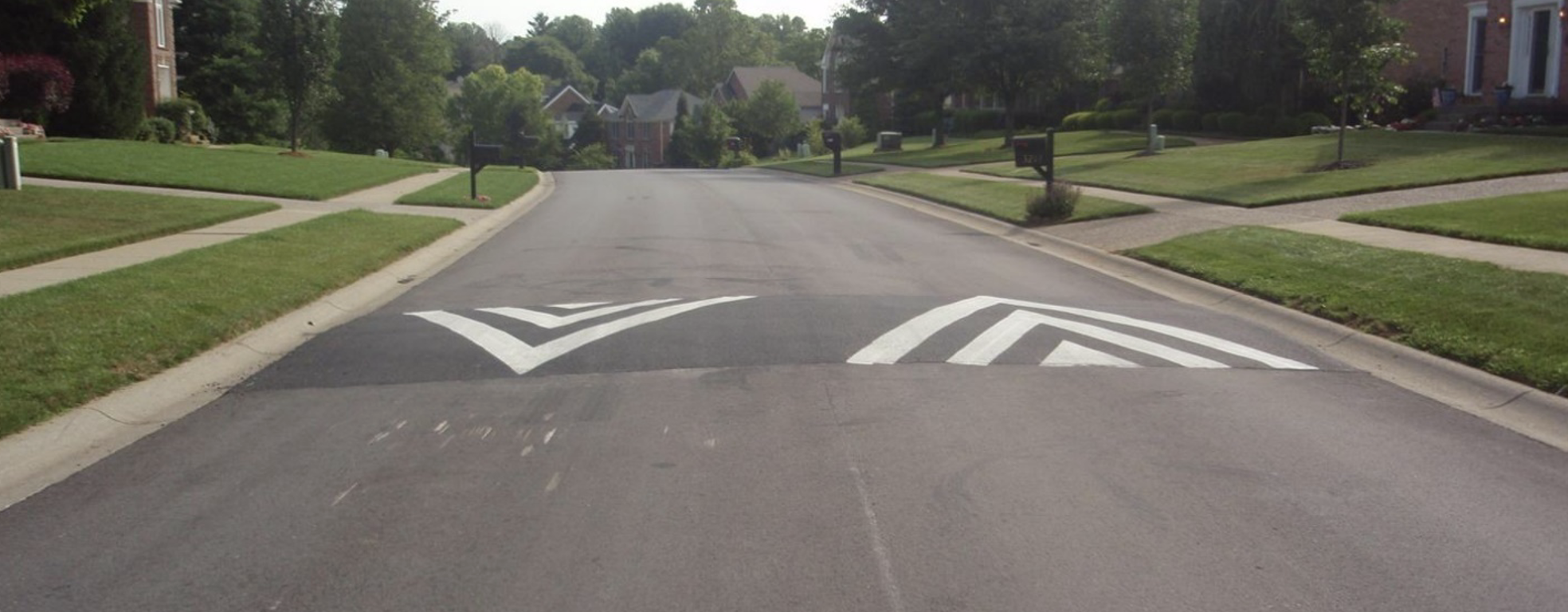
Image Source: Louisville Metro Public Works
DEFINITION AND DESCRIPTION
A speed hump is an elongated mound in the roadway pavement surface that extends across the travel way perpendicular to the traffic flow. A speed hump discourages speeding by producing discomfort if a motorist exceeds the design speed while driving over it.
Five field studies of 51 speed humps measured crash reductions between 33% and 48%. Seven field studies of 199 speed humps measured speed reductions between 6 mph and 13 mph for 85th percentile speeds (FHWA, Engineering Speed Management Countermeasures: A Desktop Reference of Potential Effectiveness in Reducing Crashes, July 2014).
Implementation Categories
| Area(s) | Design and Geometrics, HSIP, Operations & Maintenance |
| Safety Category | 2 |

CONSIDERATIONS
- Do not install on sharp curves; ITE Guidelines for the Design and Application of Speed Humps recommends a minimum horizontal curve radius of 300 feet.
- Do not install near an intersection.
- Generally, not appropriate for transit routes or primary emergency vehicle routes.
- ITE Guidelines for the Design and Application of Speed Humps recommends their use only on streets with a grade of 8% or less.
- On roadways without curbing, delineator posts or signs may be used to discourage motorists from driving around the hump.
- Speed humps can be used on roadways with bicycle lanes.
- Speed cushions are similar to speed humps, but they have cut outs to enable a vehicle with a wide track (e.g., a large emergency vehicle, some trucks, some buses) to pass though the feature without vertical deflection.
- Snowplows can drive over speed humps.
- Speed humps may be constructed using asphalt, concrete, or prefabricated rubber.
- Coordinate with local officials and stakeholders.
APPLICATION
- May be an option on local residential streets and streets providing access to a school or park. The posted speed limit should be ≤ 30 mph and traffic volumes should be relatively low.
- A speed hump typically measures 3 inches high and 12 feet in length along the vehicle travel path axis.
- Install speed humps at least 1 foot from curb or 6 inches from non-curbed road for drainage.
- Install a sign upstream of the speed hump that warns drivers of its presence. (MUTCD W17-1). See Sections 29 and 3B.30 of the MUTCD for information on using markings at and in advance of speed humps. The speed hump sign should be supplemented with an Advisory Speed plaque (see Section 2C.46 of the MUTCD).
- ITE Guidelines for the Design and Application of Speed Humps recommends spacing of 260 feet – 500 feet to maintain an 85th percentile operating speed of 25 mph – 30 mph. Spacing can be adjusted to achieve speeds closer to the target speed.
example
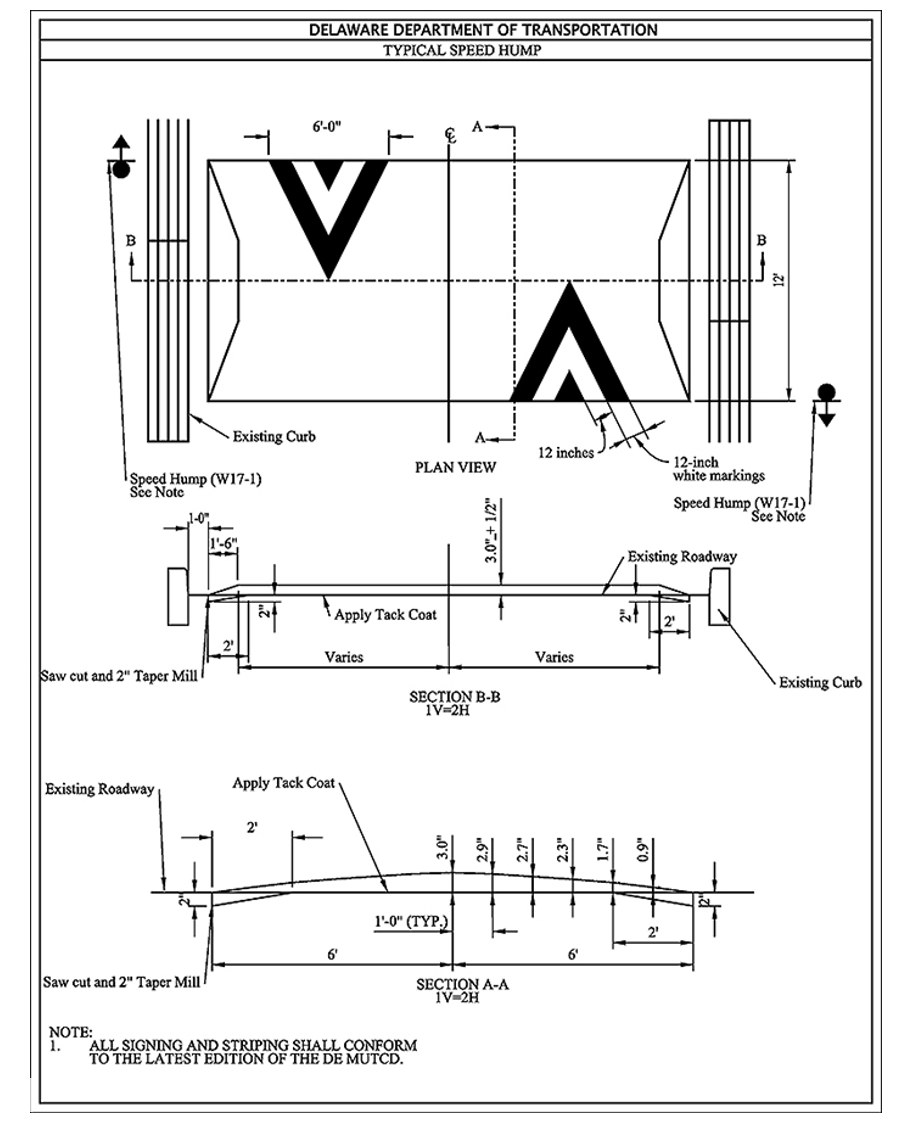
Image Source: Delaware DOT
complementary SSA Strategies
REFERENCES AND RESOURCES
Federal Highway Administration. Manual on Uniform Traffic Control Devices for Streets and Highways (MUTCD), Federal Highway Administration, U.S. Department of Transportation, Washington DC, 2023. https://mutcd.fhwa.dot.gov/kno_11th_Edition.htm
FHWA, Engineering Speed Management Countermeasures: A Desktop Reference of Potential Effectiveness in Reducing Crashes, July 2014. https://highways.dot.gov/safety/speed-management/engineering-speed-management-countermeasures-desktop-reference-potential
Institute of Transportation Engineers. A Guide to Vertical Deflection Speed Reduction Techniques: Planning and Design of Speed Humps, Speed Tables and Other Related Measures, December 2022. https://www.ite.org/technical-resources/topics/traffic-engineering/guide-to-vertical-deflection-speed-reduction-techniques/
CONTACT:
Jill Asher
Research Engineer
jill.asher@uky.edu