
Speed Tables and Raised Crosswalks

DEFINITION AND DESCRIPTION
A speed table is a raised area installed across the roadway to limit vehicle speeds. It extends across the roadway and has a flat top sufficiently long (typically, 10 feet) to accommodate the entire wheelbase of most passenger vehicles. Compared to speed humps, their extended longitudinal depth in the direction of travel enables faster vehicle operating speeds while preserving motorist comfort and safety. Raised crosswalks may be placed on top of speed tables.
Three field studies of 27 speed tables measured crash reductions of 36% – 64%. Six field studies of 98 speed tables measured reductions in 85th percentile speeds of 4 mph – 11 mph (FHWA, Engineering Speed Management Countermeasures: A Desktop Reference of Potential Effectiveness in Reducing Crashes, July 2014). Raised crosswalks can reduce pedestrian crashes by up to 45% (FHWA, Countermeasure Tech Sheet, June 2018).
Implementation Categories
| Area(s) | Design & Geometrics, HSIP, Operations & Maintenance |
| Safety Category | 2 |
CONSIDERATIONS
- Do not install on sharp curves; ITE Guidelines for the Design and Application of Speed Humps recommends a minimum horizontal curve radius of 300 feet.
- Speed tables may be used at intersections or mid-block crossings as raised crosswalks.
- If used at intersections, consider the impact on required intersection sight distance since vehicles turning across the raised crosswalk from a stopped position will accelerate more slowly to enter the intersection.
- Drivers turning across a raised crosswalk from an uncontrolled approach will require more intersection sight distance since they will be required to find an adequate gap in traffic and then reduce their speed to navigate the vertical deflection.
- Consider drainage in design.
- Generally, not appropriate for transit routes, primary emergency vehicle routes, or along routes that provide primary access to commercial or industrial sites (freight).
- ITE Guidelines for the Design and Application of Speed Humps recommends consideration only on a street with a grade of 8% or less.
- On roadways without curbing, delineator posts or signs may be used to discourage motorists from driving around the hump.
- Speed tables can be used on roadways with bicycle lanes.
- Raised pedestrian crossings are one of the four treatments that fulfill the PROWAG requirement (R306.4.2) for multilane crossings at roundabouts.
APPLICATION
- May be appropriate for local and collector streets with low operating speeds and an AADT < 9,000 and on arterials in certain circumstances.
- Typically, speed tables are elevated approximately 3 inches, while speed tables with crosswalks range from 3 inches to the height of the sidewalk. Transition slopes range from approximately 12:1 to 25:1. Longer approaches and plateaus are better able to accommodate large vehicles but may also result in higher vehicle speeds.
- ITE Guidelines for the Design and Application of Speed Humps recommends spacing of 260 feet – 500 feet between successive speed bumps to maintain 85th percentile operating speeds of 25 mph – 30 mph. Spacing can be adjusted to achieve speeds closer to the target speed.
- Install signs upstream of the installation to warn drivers (MUTCD W17-1). Where a speed table is designated as a pedestrian crossing, a pedestrian sign may be used instead. See Sections 29 and 3B.30 of the MUTCD for information on using markings at and in advance of speed tables.
example
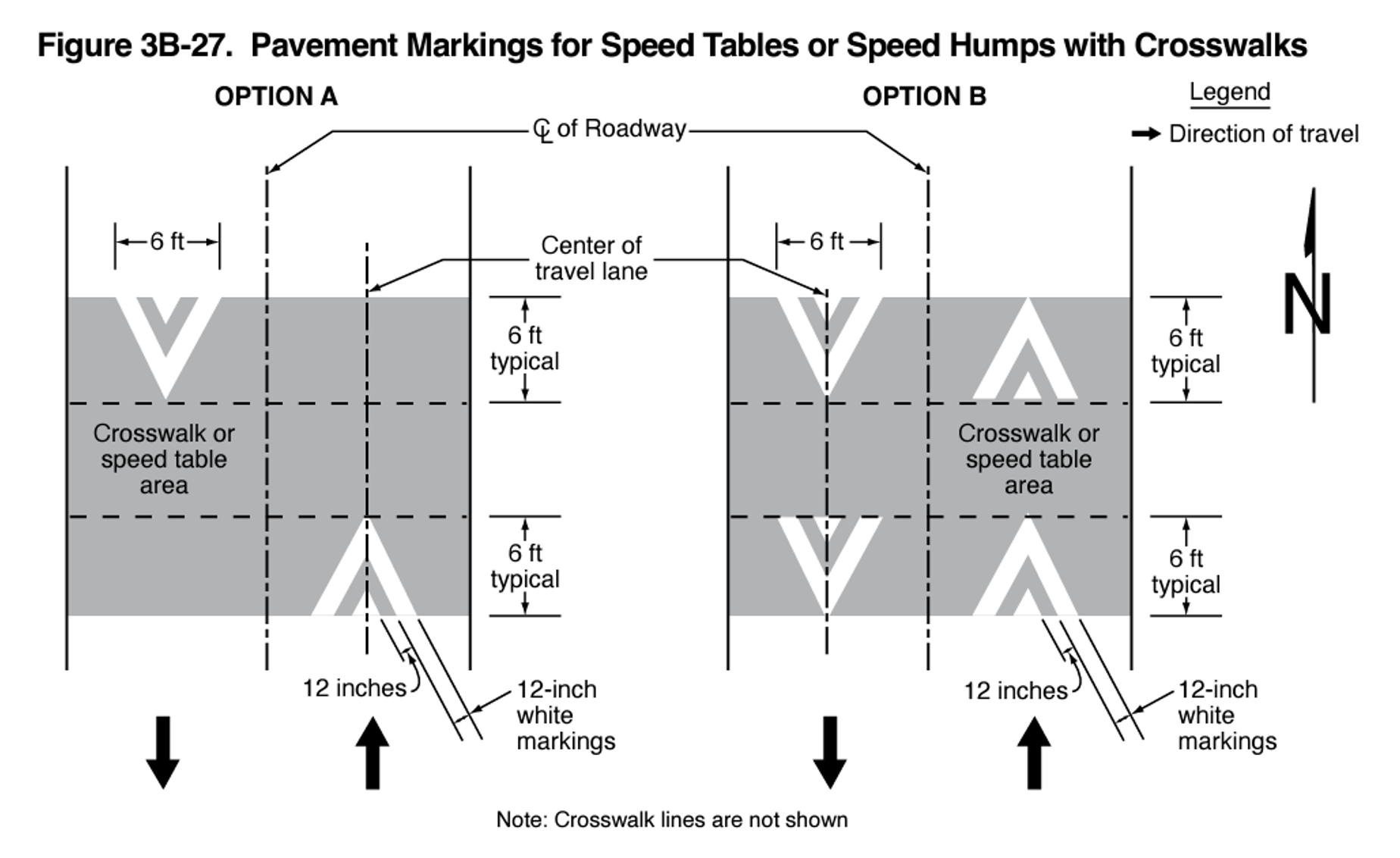
Source: MUTCD 11th Edition
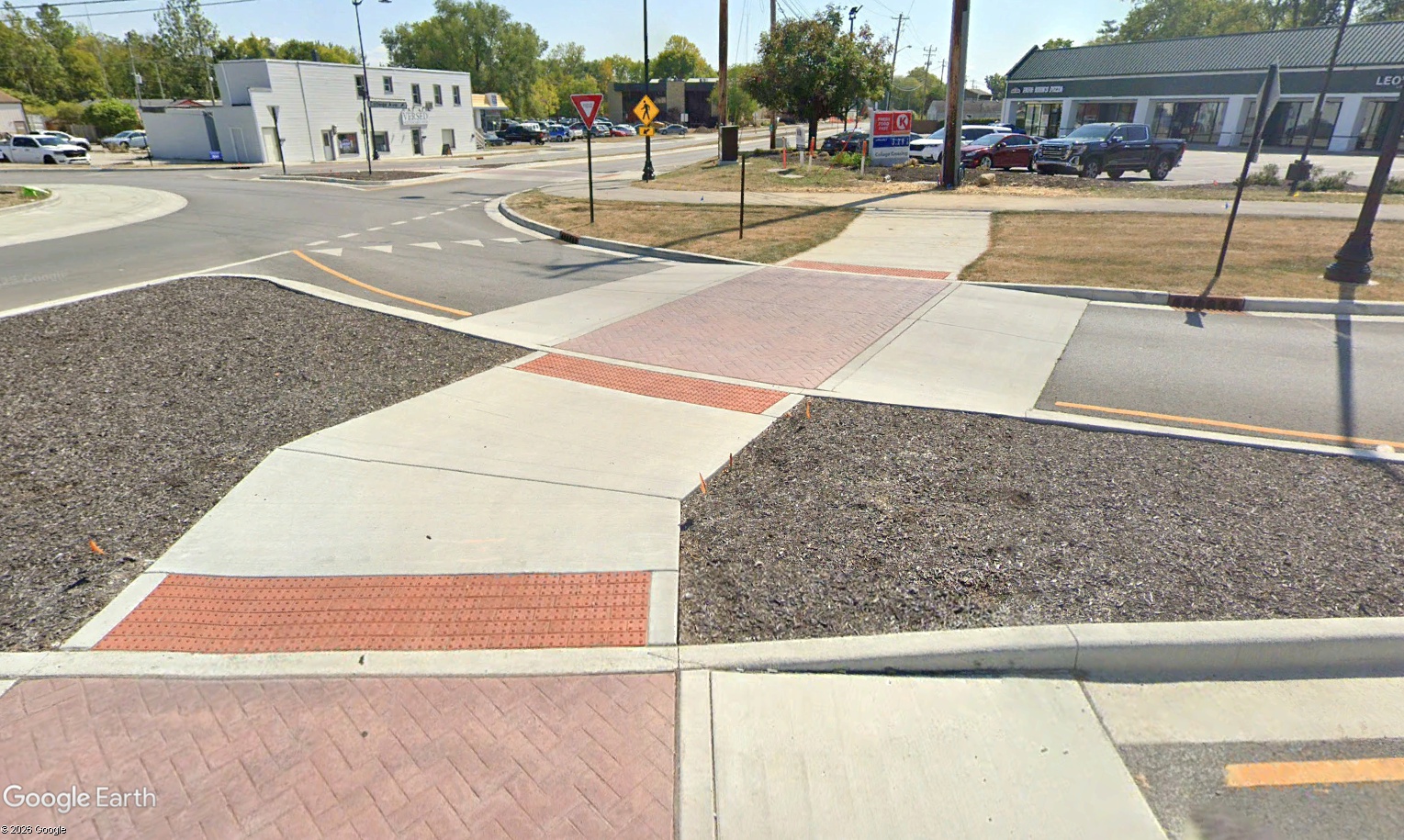
Image Source: Google Earth, Carmel, IN
complementary SSA Strategies
- Medians and Pedestrian Refuge Islands
- Supplemental In-Lane Pavement Markings
REFERENCES AND RESOURCES
Federal Highway Administration. Manual on Uniform Traffic Control Devices for Streets and Highways (MUTCD), Federal Highway Administration, U.S. Department of Transportation, Washington DC, 2023. https://mutcd.fhwa.dot.gov/kno_11th_Edition.htm
FHWA, Engineering Speed Management Countermeasures: A Desktop Reference of Potential Effectiveness in Reducing Crashes, July 2014. https://highways.dot.gov/safety/speed-management/engineering-speed-management-countermeasures-desktop-reference-potential
FHWA, Countermeasure Tech Sheet – Raised Crosswalk, June 2018. https://highways.dot.gov/sites/fhwa.dot.gov/files/2022-06/techSheet_RaisedCW2018.pdf
Institute of Transportation Engineers. A Guide to Vertical Deflection Speed Reduction Techniques: Planning and Design of Speed Humps, Speed Tables and Other Related Measures, December 2022. https://www.ite.org/technical-resources/topics/traffic-engineering/guide-to-vertical-deflection-speed-reduction-techniques/
CONTACT:
Jill Asher
Research Engineer
jill.asher@uky.edu