
Successively Smaller Curves
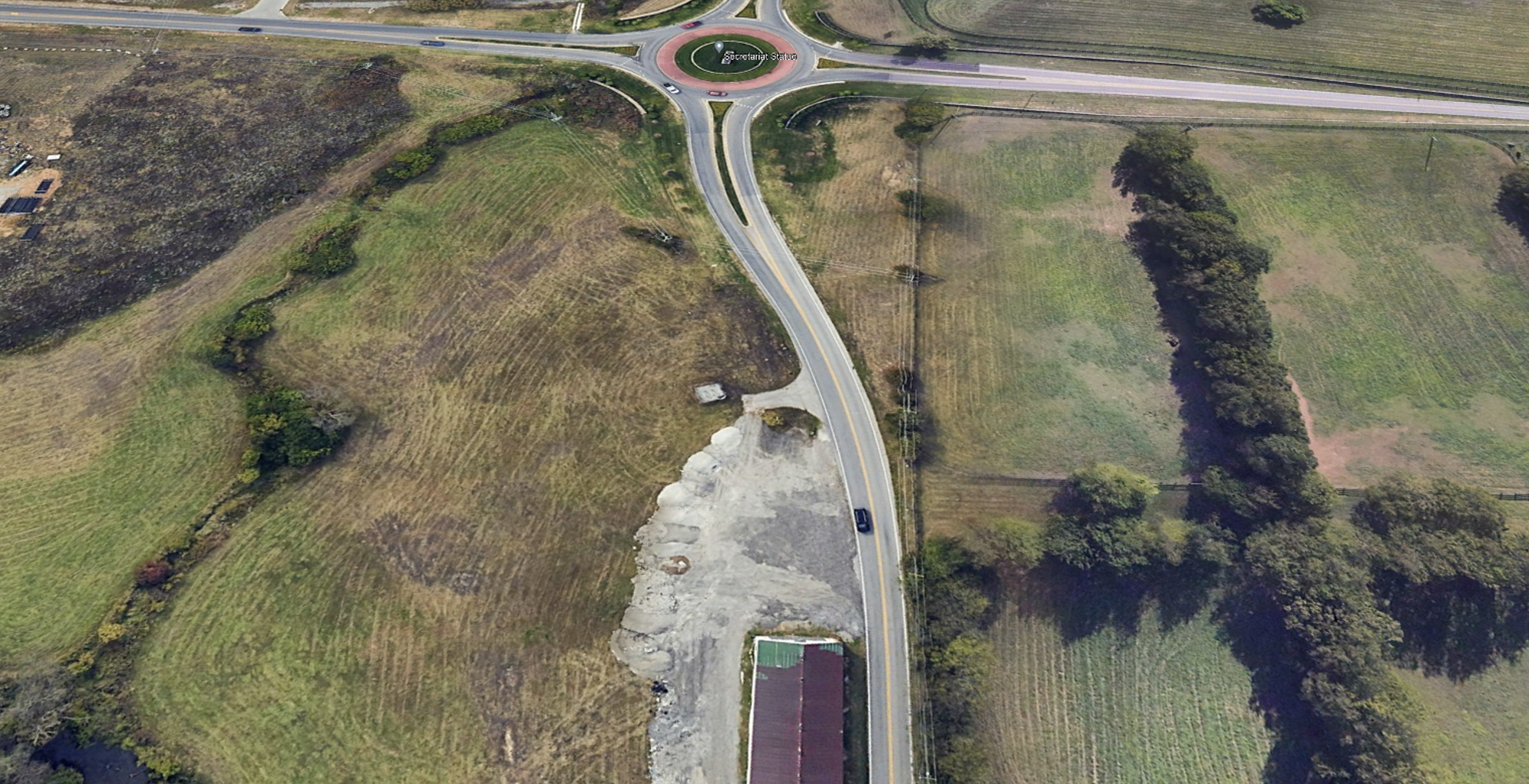
Image Source: Google Earth
DEFINITION AND DESCRIPTION
A series of progressively sharper curves creates a self-enforcing roadway that encourages motorists to reduce speeds. These commonly take the form of reverse curves separated by a tangent, where a broad-radius curve is followed by a moderate-radius curve. Actual speeds associated with these radii vary by roadway approach speed and deceleration needs.
Implementation Categories
| Area(s) | Design & Geometrics |
| Safety Category | 2 |

CONSIDERATIONS
- Successive curves should not introduce speed differentials of more than 10 mph – 15 mph between each curve.
- May be used in speed transition zones.
- Applicable to new construction and reconstruction projects.
- The required length of the deceleration zone depends on the distance required to decelerate from the approach design speed to the target speed (See the AASHTO Green Book, Figure 2-34).
- Curve radii are calculated using the AASHTO Green Book (2018), Equation 3-8, with side-friction factors from Figure 3-4.
- Often used on high-speed roundabout approaches, freeway exit ramps, and speed transitions on rural highways.
- Ensure adequate sight distance is maintained through the sequence of curves.
APPLICATION
- Use in areas of speed transition zones in rural or suburban contexts on new construction or reconstruction projects.
- Effective at roundabout approaches and exit ramps where speed reduction is critical.
- Apply AASHTO criteria to design horizontal curvature. Guidance is also available in Section 5.2 of KYTC’s Roundabout Design Guidance.
example
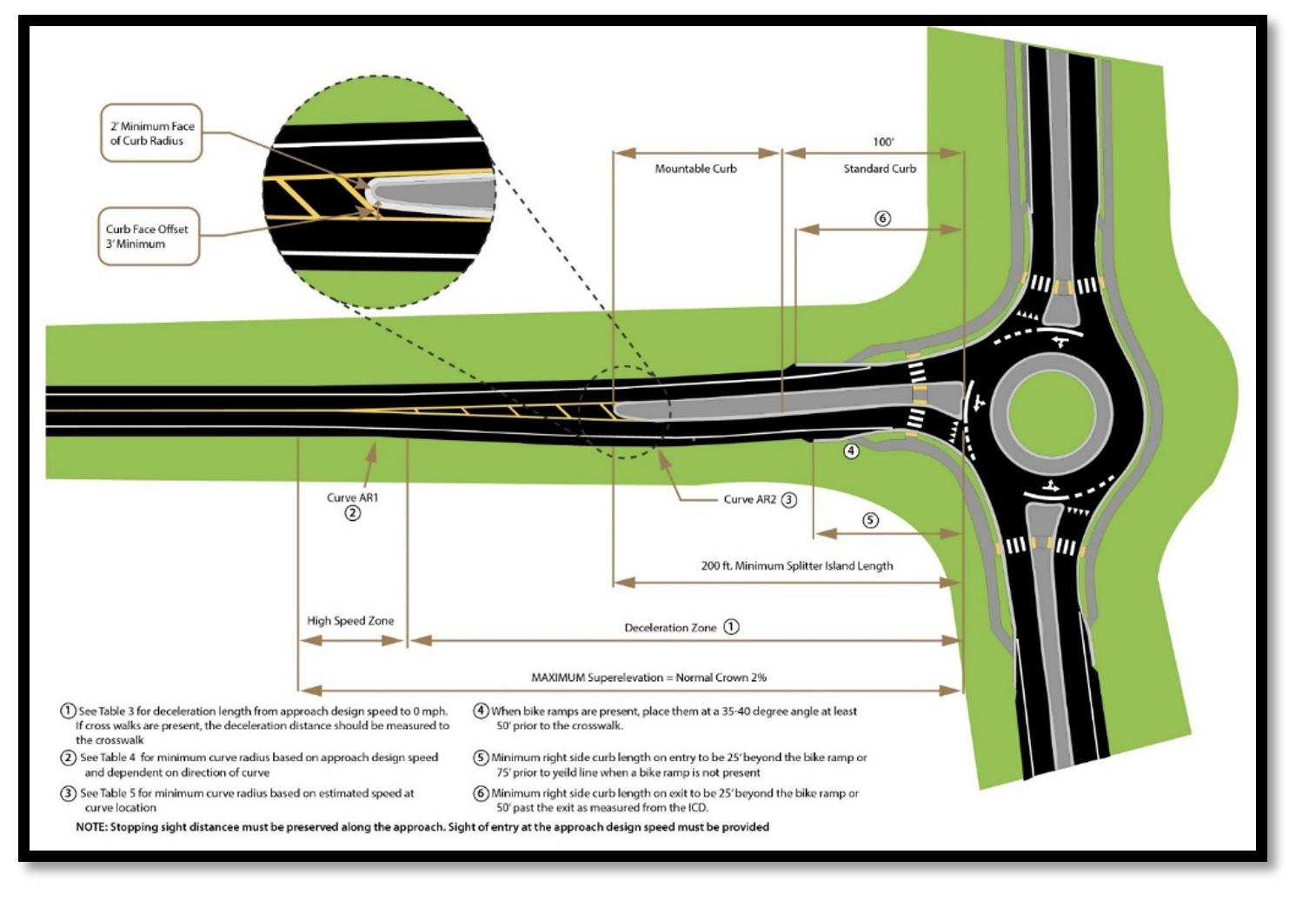
Image Source: KYTC Roundabout Design Guidance
Complimentary Countermeasures
- Medians and Pedestrian Refuge Islands
REFERENCES AND RESOURCES
KYTC Roundabout Design Guidance. https://transportation.ky.gov/Highway-Design/Documents/Roundabout%20Design%20Guidance%20Policy.pdf
CONTACT:
Jill Asher
Research Engineer
jill.asher@uky.edu