
Transverse Pavement Rumbles

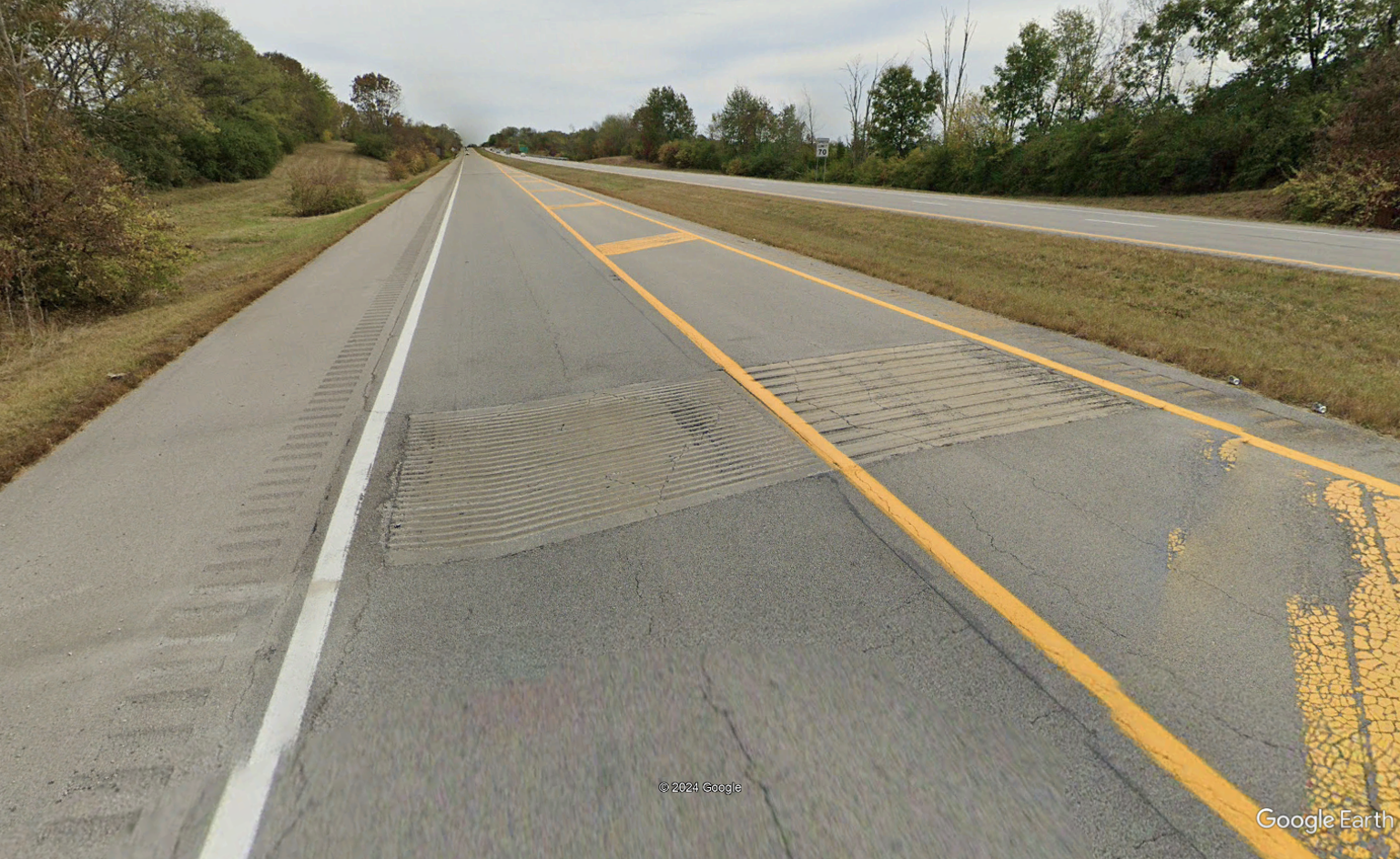
Source: Google Earth, Frankfort, KY
DEFINITION AND DESCRIPTION
Transverse rumble strips are placed in travel lanes perpendicular to the direction of travel. The noise tires make when they contact the rumbles alert motorists to slow down. They are typically located on approaches to intersections, horizontal curves, work zones, and the ends of freeways.
Implementation Categories
| Area(s) | Design and Geometrics, Traffic Operations and Operations & Maintenance |
| Safety Category | 4 |

CONSIDERATIONS
- Where turn lanes are not needed for operational purposes, a TWLTL may be reconfigured to incorporate raised, depressed, or flush medians.
- See MUTCD Section 3K.02 for more information on transverse rumble strip markings. The MUTCD does not include guidance on the design or placement of the transverse rumble strips. See Traffic Operations Guidance Manual TO-801 for additional information, including guidance on the design and placement of transverse rumble strips.
- Can be used to address roadway departures and right-angle crashes caused by motorists not being aware of an intersection.
- May be thermoplastic or milled in. Typically, rumble strips are extruded or preformed thermoplastic.
- KYTC District Offices can install transverse pavement rumble in a temporary manner. Permanent applications require the approval of the Division of Traffic.
- They can lower crash numbers 28% – 35% (FHWA).
- Motorists may make unusual maneuvers to avoid transverse rumble strips.
- Do not use in curves or within the stopping distance for actual stop conditions.
- Studies have found no statistically significant difference in performance of sinusoidal mumble strips compared to rectangular rumble strips.
APPLICATION
- May be applied to warn of stop or near-stop conditions on high-speed roadways and on approaches to horizontal curves or work zones.
- Installation should consist of three sets of eight strips constructed uniformly at right angles to the center of the roadway with sets spaced approximately 200 feet apart.
- Requirements for different methods of implementation:
- Extruded thermoplastic material — Include 2 layers of thermoplastic material to establish a total thickness of 3/8 inch. Widths of individual strips should be 6 inches with a 24-inch space between strips.
- Preformed thermoplastic material — Follow manufacturer’s recommendations.
- Cut or milled strips (permanent) — Maximum depth of 3/8 inch, width of 7 inches, and spacing of 24 inches between strips.
- Two flexible delineator posts shall be installed at each location. The delineator posts shall be constructed in such a manner that the top of the posts are 4 ft above the top of the near edge of pavement. The reflective surface shall point toward the center line of the roadway approximately ¼ mile away.
- To avoid impacts to bicyclists, do not install strips on the outer 2 feet of the traveled lane unless there is a minimum of 4 feet of paved shoulder, outside the normal shoulder rumble strips, along the roadway.
example
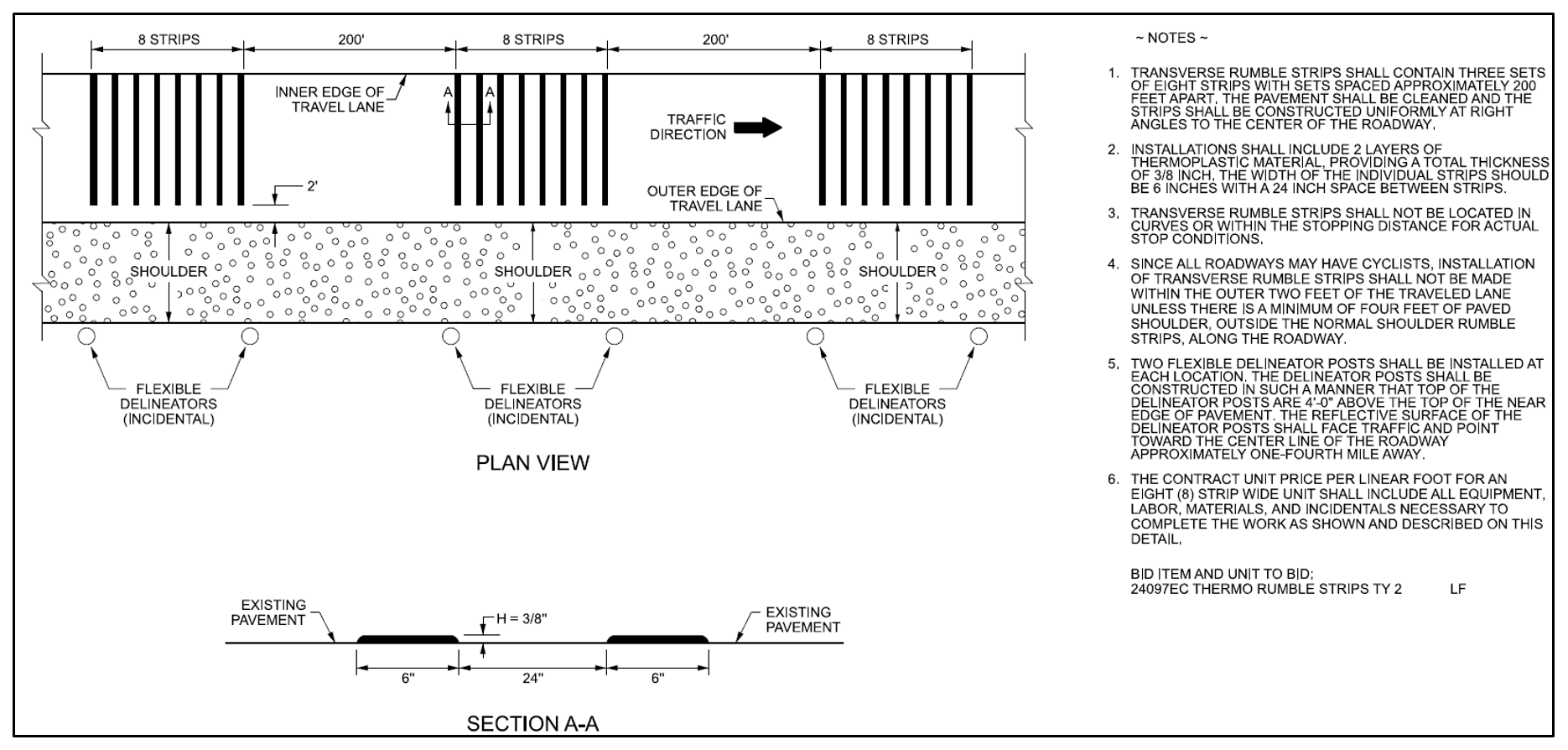
Source: KYTC’s HSIP Project Development Resources – Thermo Rumble Strips Type 2
complementary SSA Strategies
REFERENCES AND RESOURCES
FHWA, Safety Evaluation of Transverse Rumble Strips on Approaches to Stop-Controlled Intersections in Rural Areas. FHWA-HRT-12-047. https://www.fhwa.dot.gov/publications/research/safety/hsis/12047/index.cfm
FHWA, Intersection Safety: A Manual for Local Rural Road Owners. https://highways.dot.gov/safety/local-rural/intersection-safety-manual-local-rural-road-owners/4-countermeasures
KYTC Traffic Operations Manual, TO-801
CONTACT:
Jill Asher
Research Engineer
jill.asher@uky.edu