
Centerline Buffers

DEFINITION AND DESCRIPTION
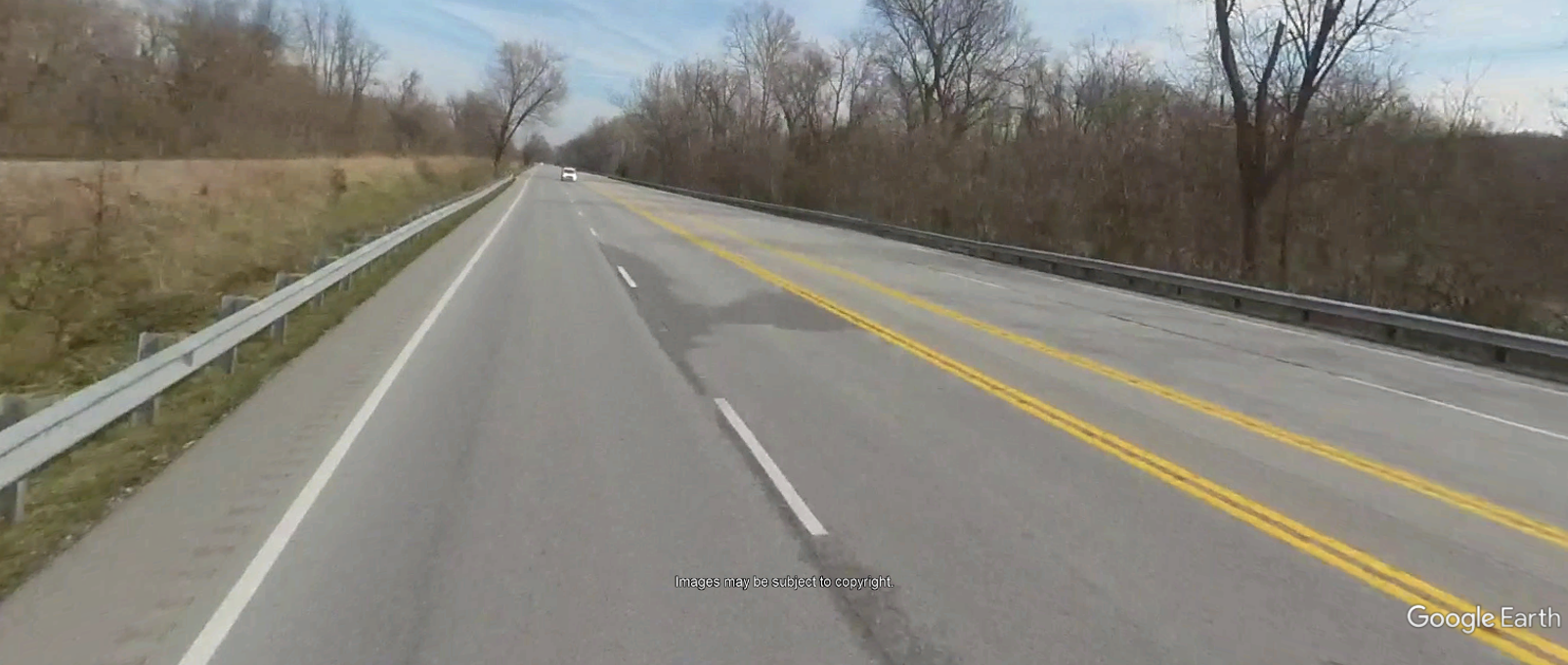
Centerline buffer areas establish additional space between centerline markings, increasing separation between opposing traffic on undivided roadways. Rumble stripes along the buffer edges alert drivers, while the buffer itself provides space for an errant vehicle to recover, helping reduce head-on crashes.
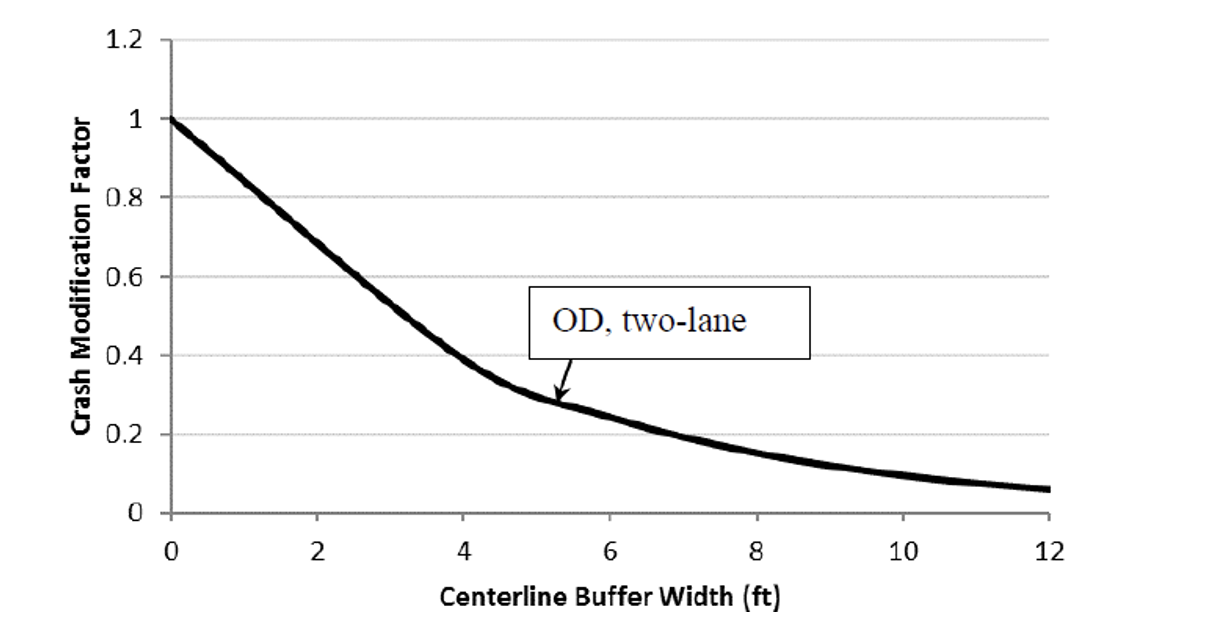
Image Source: Dixon, et.al.,2022
Implementation Categories
| Area(s) | Design & Geometrics, HSIP, Operations & Maintenance |
| Safety Category | 1, 2 |

CONSIDERATIONS
- A buffer width of around 4 feet is recommended, with an acceptable range from a minimum of 2 feet to a maximum of 6 feet.
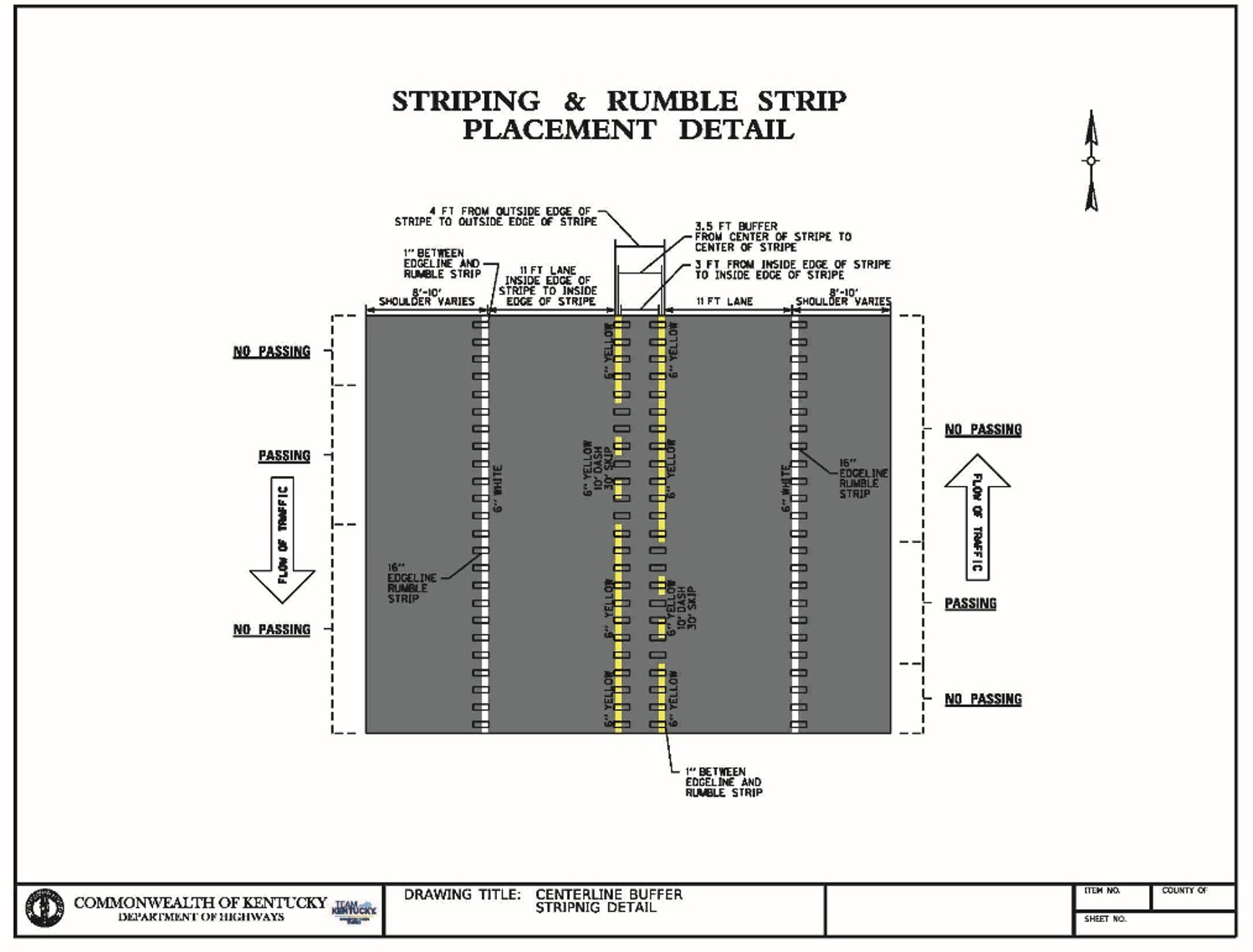
- A striping detail is under development by KYTC to establish guidance for striping and rumble strip placement. KYTC projects will need to use the KYTC detail when it is completed.
- Additional guidance is also being developed for marking of passing zones on two-lane roadways, where the goal is to allow passing while also providing a continuous centerline buffer.
- Maintain adequate lane and shoulder widths.
- When restriping existing roadways, evaluate the shoulder’s pavement structure before converting it to a travel lane.
- When trenching the existing shoulder to create a full-depth section, a minimum width of 6 feet is recommended to ensure proper compaction.
- Included as an engineering strategy in KYTC’s SHSP.
APPLICATION
- May be used on high-speed two-lane and undivided four-lane facilities.
- May be included in new or reconstruction projects or implemented through roadway reconfigurations.
example
complementary SSA Strategies
REFERENCES AND RESOURCES
Dixon, K., E. Park, S. Geedipally, R. Srinivasan, B. Lan, C. Zegeer, S. Das, E. Rista. NCHRP Report 995: Guidelines for Treatments to Mitigate Opposite Direction Crashes. 2022. Transportation Research Board of the National Academies, Washington, DC: The National Academies Press. https://doi.org/10.17226/26586.
FHWA. Rural Roadway Departure Countermeasure Pocket Guide. https://highways.dot.gov/safety/rwd/forrrwd/rural-roadway-departure-countermeasure-pocket-guide
FHWA. Safe System Roadway Design Hierarchy. 2024. FHWA-SA-22-069. https://highways.dot.gov/sites/fhwa.dot.gov/files/2024-01/Safe_System_Roadway_Design_Hierarchy.pdf
FHWA. Rumble Strips and Rumble Stripes. https://safety.fhwa.dot.gov/roadway_dept/pavement/rumble_strips/fhwasa16115/ch6.cfm
CONTACT:
Jill Asher
Research Engineer
jill.asher@uky.edu