
Roadway Narrowing: Pavement Markings
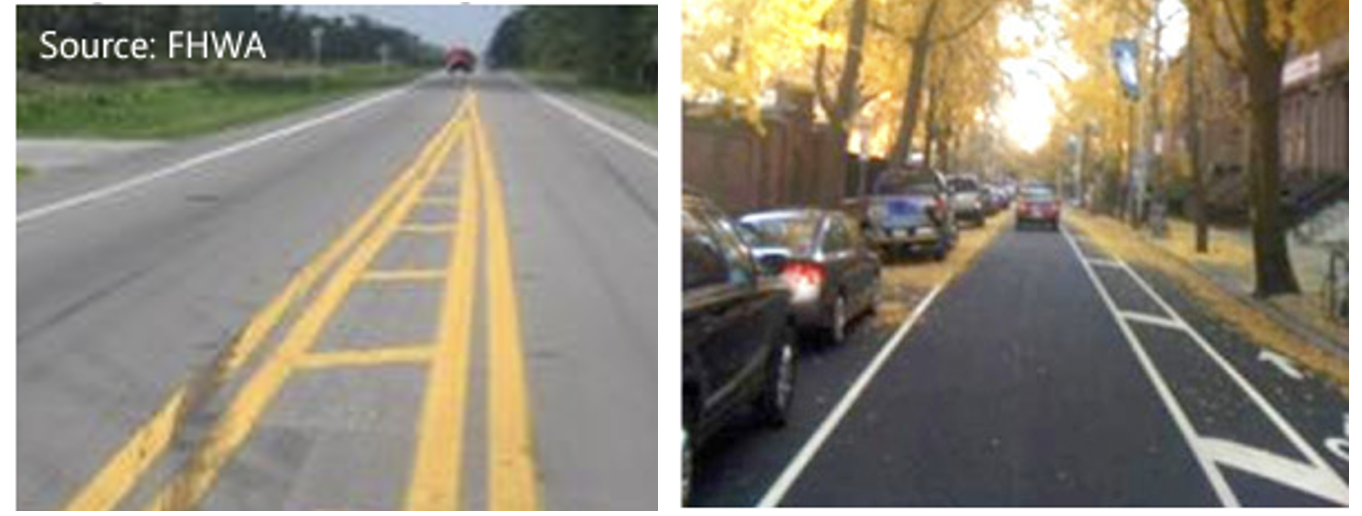
Image Source: FHWA
DEFINITION AND DESCRIPTION
Roadway narrowing is often done as part of resurfacing or roadway improvement projects. It may include repurposing additional paved space with markings or physically removing unused paved areas. Narrower lanes encourage reduced operating speeds, and excess width may be used to accommodate complementary safety strategies.
Implementation Categories
| Area(s) | Design and Geometrics, Traffic Operations and Operations & Maintenance |
| Safety Category | 2 |

CONSIDERATIONS
- Space freed up by narrowing lanes can be used for wider centerline buffers, non-motorized uses, parking, or wider shoulders that can accommodate rumble strips in rural areas.
- May be considered as part of resurfacing projects to minimize cost.
- Reduces speeds 2 mph – 3 mph (NCHRP 737).
- Large vehicle operations may be impacted.
- KYTC’s Highway Design Guidance Manual outlines minimum widths of travel lanes for different roadway classifications.
APPLICATION
- May be used:
- For local, collector, and arterial streets where sufficient width is available.
- In speed transition zones alongside other traffic calming strategies.
- On high-speed rural roads to increase shoulder widths where wide striped lanes are present.
- Pavement marking updates can be coordinated with the pavement resurfacing schedule.
example
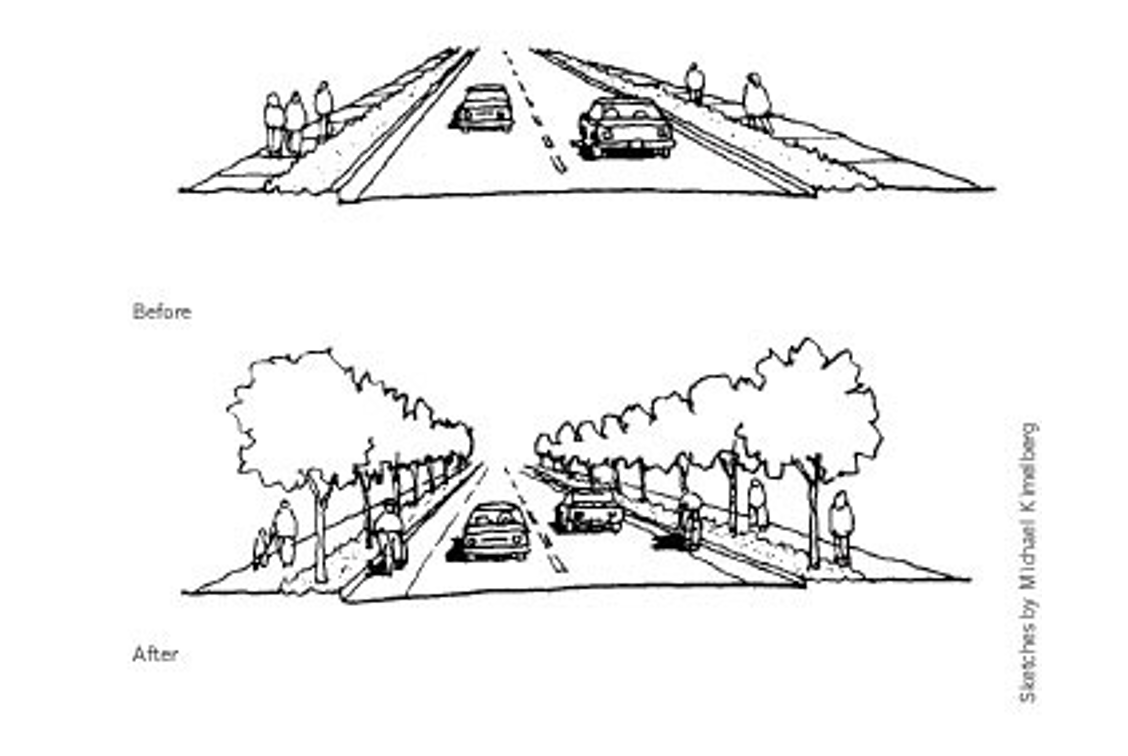
Image Source: FHWA
Complementary SSA Strategies
REFERENCES AND RESOURCES
FHWA, Selecting Pedestrian Safety Improvements https://pedbikesafe.org/PEDSAFE/countermeasures_detail.cfm?CM_NUM=18
FHWA, Traffic Calming ePrimer. https://highways.dot.gov/safety/speed-management/traffic-calming-eprimer#eprimer
KYTC Complete Streets, Roads, and Highways Manual, 2022. https://transportation.ky.gov/BikeWalk/Documents/Complete%20Streets,%20Roads,%20and%20Highways%20Manual.pdf
Torbic, D., D. Gilmore, K. Bauer, C. Bokenkroger, D. Harwood, L. Lucas, R. Frazier, C. Kinzel, D. Petree, and M. Forsberg, NCHRP Report 737: Design Guidance for High-Speed to Low-Speed Transition Zones for Rural Highways, Transportation Research Board of the National Academies, Washington, D.C., 2012. https://www.nationalacademies.org/read/22670
CONTACT:
Jill Asher
Research Engineer
jill.asher@uky.edu