
Using Traffic Signal Timing to Meet Target Speeds


DEFINITION AND DESCRIPTION
Conventional traffic calming techniques are not usually applicable for controlling speeds on urban and suburban arterials. Due to the presence of vulnerable road users on these facilities, speed management is important, but enforcement is difficult to accomplish using traditional methods. On corridors with traffic signal systems, case studies show that is possible to substantially reduce speeding opportunities with little or no impacts to vehicle delays by reducing cycle length and progression speed and dividing the arterial into smaller “coordination zones” (Furth et.al., 2018).
Implementation Categories
| Area(s) | TSMO |
| Safety Category | 2 |

CONSIDERATIONS
- Can be applied on urban and suburban arterials.
- Shorter cycle lengths can reduce pedestrian wait times and encourage pedestrians to cross during the pedestrian walk interval.
- Reducing cycle length from 100 seconds to 80 seconds reduces speeding opportunities up to 28% without any change in vehicle delay (and with a 23% decrease in pedestrian delay) (Furth, 2018).
APPLICATION
- Assess shortening signal cycle lengths and smaller coordination zones for signal systems.
- Use target speeds as progression speeds for the signal system.
example
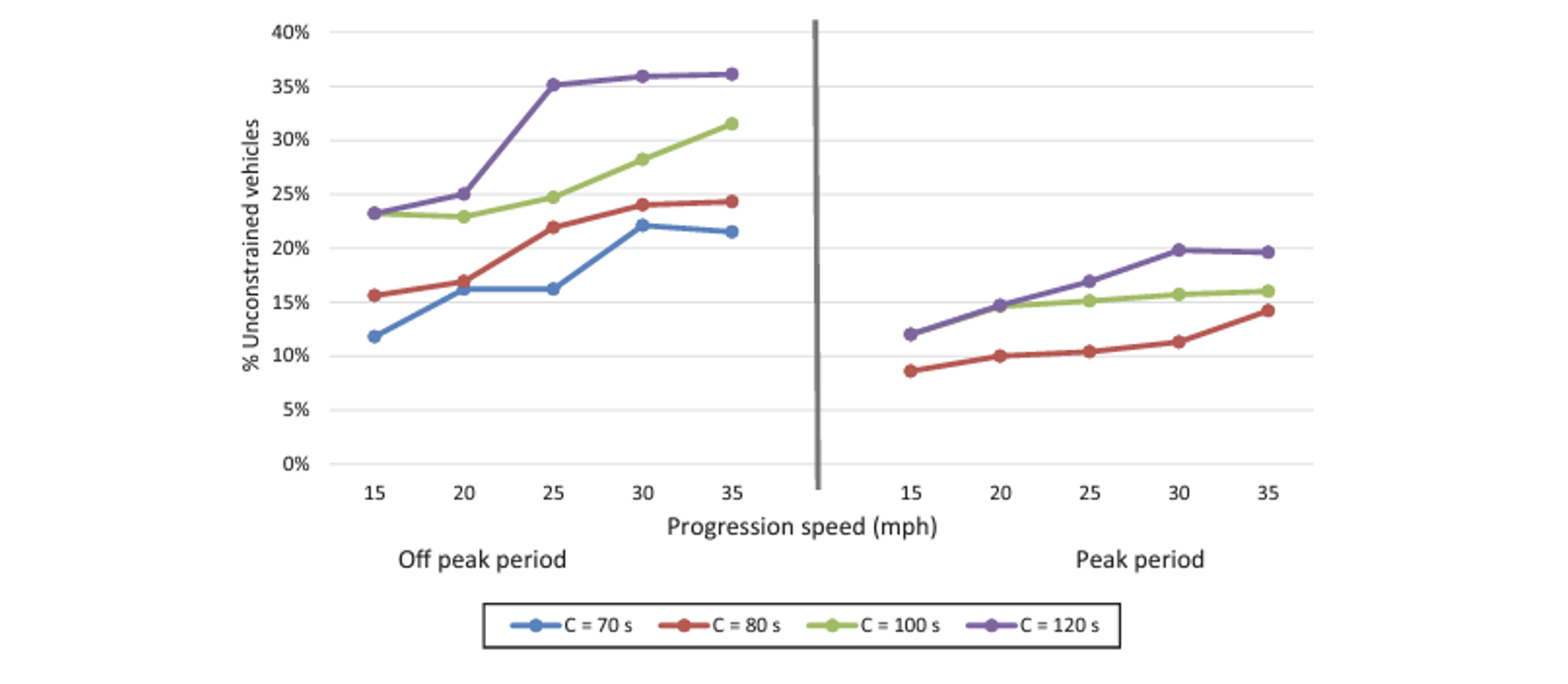
Image Source: (Furth et.al., 2018)
complementary SSA Strategies
REFERENCES AND RESOURCES
Furth P., Halawani A. T., Li J., Hu W., and Cesme B. Using Traffic Signal Control to Limit Speeding Opportunities on Bidirectional Urban Arterials. (2018). Transportation Research Record: Journal of the Transportation Research Board, 2018. 2672: 107-116. https://trid.trb.org/View/1496118
CONTACT:
Jill Asher
Research Engineer
jill.asher@uky.edu