
Protected Intersection
DEFINITION AND DESCRIPTION
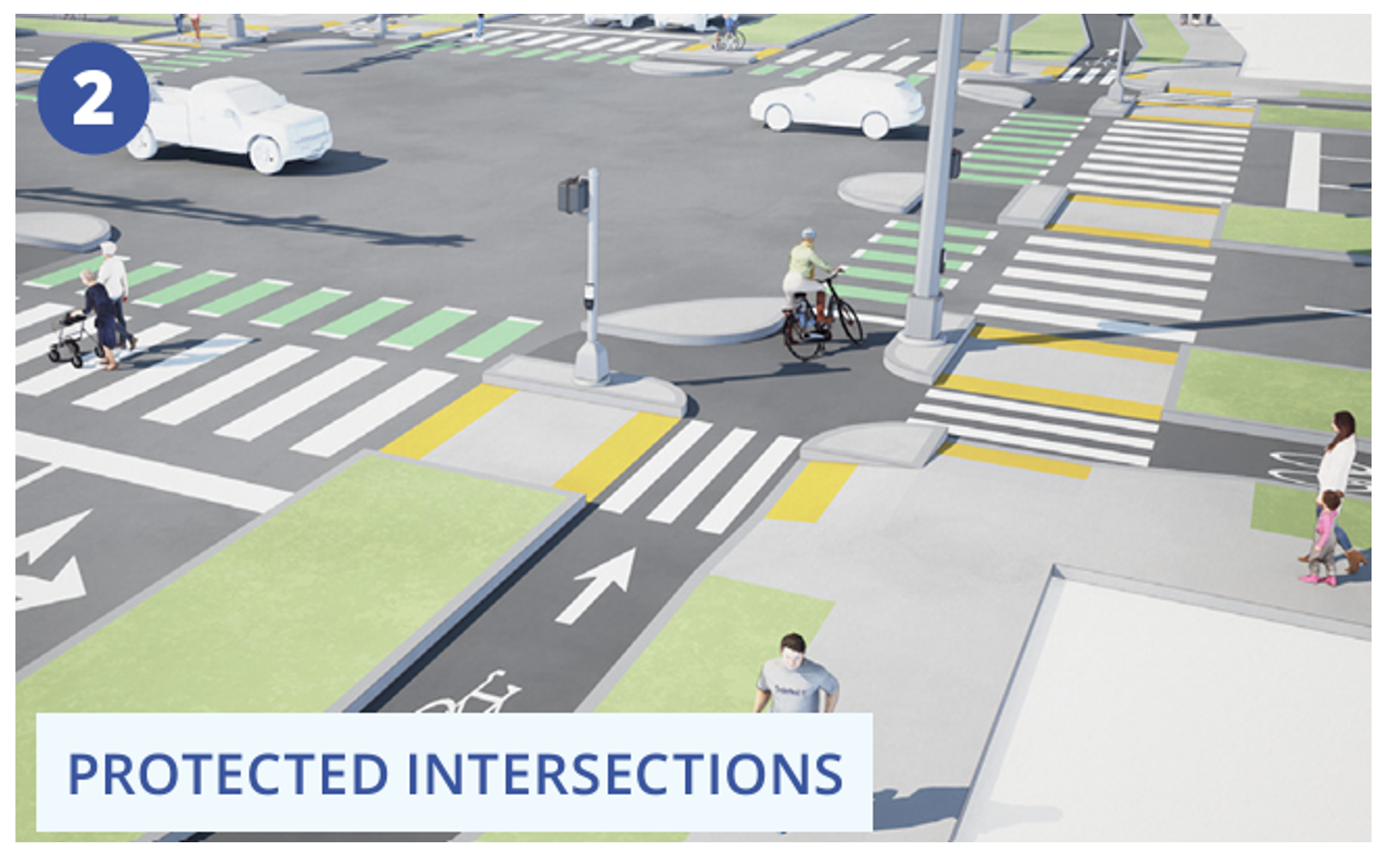
Protected intersections use a setback or offset design to minimize conflict points and improve visibility between drivers, pedestrians, and/or bicyclists. Features of protected intersections include pedestrian refuge islands, bicycle queuing areas, corner islands, and clear crossing markings. The purpose of these features is to safeguard all road users and improve predictability. When building a protected intersection, it is essential to consider multiple factors — including accessibility requirements — to create effective solutions adapted to the surrounding roadway context.
At protected intersections, bicyclists making right turns encounter no conflicts with vehicles and left turns can be executed in two stages, allowing bicyclists to avoid merging across lanes of traffic.
Implementation Categories
| Area(s) | HSIP, Traffic Operations |
| Safety Category | 4 |

CONSIDERATIONS
- May be used at signalized and stop-controlled intersections.
- May include bicycle signal faces.
- Turning radii may be smaller.
- Large setbacks are required. Right turns on red are generally prohibited.
- Corner islands and raised medians pose maintenance challenges, especially with snow and ice removal and resurfacing bicycle lanes.
- Quick-build options such as raised traffic lane separators and tubular markers may provide similar results at lower cost.
- If vertical elements are not feasible, painted islands and medians can still provide some protection for pedestrians and bicyclists.
- Maintenance agreements with local governments should be reviewed or updated to include responsibility for maintaining protected intersection elements located outside of the vehicle lanes.
- Provides continuity of a bike lane, enhancing bicycle mobility through an intersection while also managing vehicle speeds as drivers navigate the intersection.
APPLICATION
- May be considered at urban intersections with a buffered or separated bicycle lane that have high volumes of bicyclists and motorists.
- Corner islands may consist of curb or paint and vertical separation material like flex posts. Use of mountable truck aprons can reduce turning speeds.
example
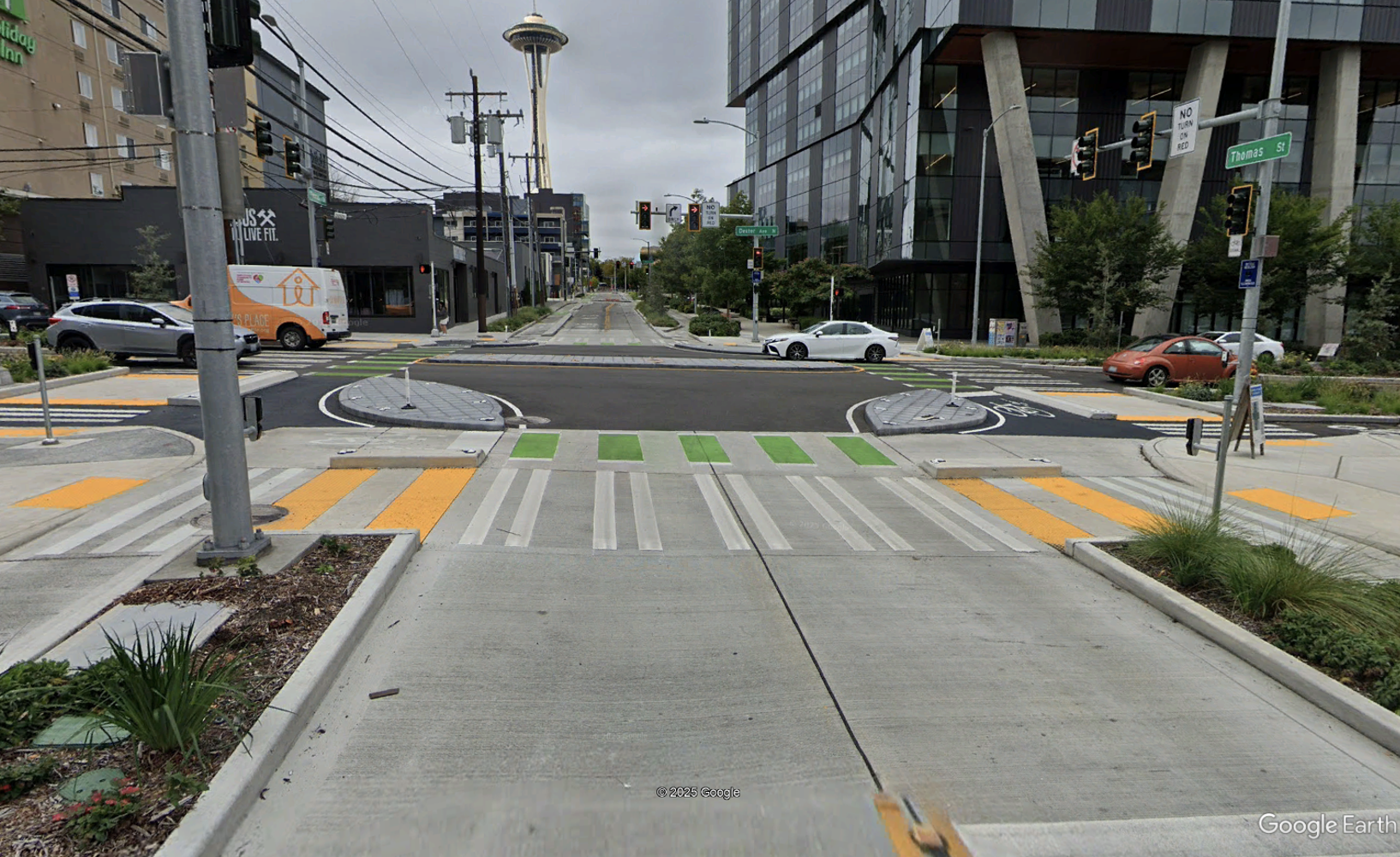
Image Source: Google Earth, Seattle, WA
Complementary SSA Strategies
REFERENCES AND RESOURCES
FHWA. Safe System Roadway Design Hierarchy. January 2024. FHWA-SA-22-069. https://highways.dot.gov/sites/fhwa.dot.gov/files/2024-01/Safe_System_Roadway_Design_Hierarchy.pdf
NACTO. (n.d.). Design strategies for signalized intersections. In Urban Bikeway Design Guide (3rd ed.). Retrieved from https://nacto.org/publication/urban-bikeway-design-guide/designing-safe-intersections/design-strategies-for-signalized-intersections/
CONTACT:
Jill Asher
Research Engineer
jill.asher@uky.edu